Quick Answer
A genuine Pashmina shawl comes from the Changthangi goat of the Himalayas. The fiber is 12 to 16 microns thin — finer than human hair. It is hand-combed, hand-spun, and handwoven. It feels impossibly soft and warm at the same time. It burns like hair, not plastic. It has a GI tag from the Indian government. And it never costs less than ₹8,000 in India or $200 internationally.
If the shawl you are holding fails even two of those points, it is very likely not genuine.
Why Fakes Are So Common — And So Convincing
The global market is flooded with shawls labeled “Pashmina” that contain zero actual Pashmina fiber. Sellers use viscose, polyester, acrylic, and cheap wool blends. They finish them beautifully. They use the right colors, the right fringe, even embroidery. From two feet away, they look identical.
This is not a new problem. It has existed for decades. But it has gotten worse as online shopping removed the ability to touch before buying.
Knowing the difference is not complicated once someone explains it clearly. That is what this guide does.
Step 1 — Understand What Real Pashmina Actually Is
Before you can spot a fake, you need to understand the real thing.
Real Pashmina comes from one specific animal: the Changthangi goat. This goat lives in Ladakh, in the high-altitude Changthang plateau where winter temperatures drop to minus 40 degrees Celsius.
To survive that cold, the goat grows an ultra-fine undercoat beneath its coarser outer fur. That undercoat is called pashm. Each spring, herders gently comb — not shear — this undercoat from the goat by hand. The goat is not harmed. The process takes time, patience, and care.
From there, the raw pashm fiber is hand-cleaned, hand-spun into thread, and hand-woven on traditional wooden looms in Kashmir. A single plain shawl takes 6 to 18 months to complete. An embroidered Kani shawl can take years.
That whole journey — from high-altitude goat to finished shawl — is why genuine Pashmina commands a high price. And why sellers use the name to sell cheap substitutes.
Key facts about genuine Pashmina fiber:
| Property | Genuine Pashmina | Regular Cashmere | Synthetic “Pashmina” |
|---|---|---|---|
| Fiber thickness | 12–16 microns | 15–19 microns | 20+ microns or plastic |
| Source animal | Changthangi goat only | Various cashmere goats | None — man-made |
| Region of origin | Ladakh, India | China, Mongolia, Nepal | Factory anywhere |
| Weaving method | Handloom in Kashmir | Machine or handloom | Machine |
| Warmth-to-weight ratio | Exceptional | Very good | Poor |
| Price range (India) | ₹8,000 – ₹5,00,000+ | ₹3,000 – ₹30,000 | ₹200 – ₹2,000 |
The 8 Tests to Identify a Genuine Pashmina Shawl
You can do most of these tests right in the store. Ask the seller confidently. A genuine seller welcomes these tests. A fake seller will hesitate, make excuses, or say, “This might damage the product.”
Test 1 — The Touch Test (Do This First, Every Time)
Pick up the shawl. Hold it against your palm.
Genuine Pashmina feels soft in a way that is hard to describe until you feel it. Not just smooth — genuinely airy and light, like holding a cloud that is somehow warm. A gentle heat builds against your skin within seconds, even at room temperature.
Run your fingers along the fabric. You will feel a very slight, natural texture — almost like the finest peach fuzz. This is the natural nap of the pashm fiber.
Synthetic shawls feel different. They feel slippery, plasticky, or unnaturally smooth. Acrylic blends sometimes feel warm but have a slightly rough, scratchy quality. Viscose feels cool and silky in the wrong way.
A genuine Pashmina also feels incredibly lightweight. A full-sized pure Pashmina shawl weighs between 150 to 200 grams. If the shawl you are holding feels noticeably heavy, it likely contains synthetic fiber or heavy wool mixed in.
Test 2 — The Burn Test (The Most Reliable Test)
This is the most definitive test you can do in person. It works because animal fibers and synthetic fibers burn completely differently.
Ask the seller for permission to pull a single thread from the fringe. Hold it over a non-flammable surface with tweezers. Light it.
Genuine Pashmina (animal fiber):
- Burns slowly
- Smells exactly like burnt human hair
- Leaves behind a soft, powdery, crumbly ash
- The flame self-extinguishes when you remove the heat source
Fake Pashmina (synthetic fiber):
- Melts or burns quickly
- Smells like burning plastic — a sharp chemical smell
- Leaves behind hard, dark beads or a solidified residue
- May drip molten material
This test does not lie. Chemistry cannot be faked. If a seller refuses to let you do this test, that refusal tells you everything.
Test 3 — The Weave Test (Hold It Up to Light)
Hold the shawl up toward a window or bright light source.
Genuine handwoven Pashmina will show tiny, irregular gaps in the weave. You will see slight variations in thread thickness. The spacing between threads is not perfectly uniform. The tension changes slightly in places.
These small “imperfections” are not defects. They are proof of a human hand at the loom. No two rows woven by hand are identical.
Machine-made fabric looks perfectly uniform under light. Every thread is the same thickness. The spacing is mathematically consistent. The pattern repeats with factory precision. That mechanical perfection is what you are looking for — and trying to avoid.
Test 4 — The Static Test (Quick and Easy)
Rub a corner of the shawl gently against itself for a few seconds.
Genuine Pashmina produces little to no static electricity. Natural animal fibers do not build up static charge the way synthetic materials do.
Synthetic shawls immediately generate static. You will feel a slight tingling. If you do this in a dark room, you may even see tiny sparks. Dust and small objects will be attracted to the fabric after rubbing.
Test 5 — The Ring Test (With Important Caveats)
This is the most famous Pashmina test. It is real but often misunderstood.
Take the shawl and gently gather it. Try to pass it through a finger ring or a small ring. A genuine fine Pashmina shawl — especially a light-weight one — can pass through a ring because the fibers are so thin and the weave is so light.
However — and this is critical — some thin synthetic shawls can also pass through a ring. The ring test alone is not enough. Use it as one of several tests, not the only test.
If the shawl absolutely cannot pass through a ring and the seller claims it is pure Pashmina, that is a stronger red flag. But passing the ring test alone does not guarantee authenticity.
Test 6 — The Fringe Test (Easy to Spot)
Look closely at the fringe — the loose threads at the short ends of the shawl.
On a genuine handwoven Pashmina, the fringe is made from the actual warp threads of the shawl, released from the loom at the end of weaving. These threads are hand-twisted and finished naturally. They are slightly uneven in length. Each strand has a hair-like, organic quality. No two fringes are identical.
On a machine-made or fake shawl, fringes are added separately and sewn or glued on. They look too uniform. They are perfectly even in length. They may be braided or knotted in a way that looks neat but is not how traditional Pashmina ends are finished.
Also, check the edges of the shawl. Genuine Pashmina has hand-stitched edges. Machine-made fakes have machine-stitched or heat-sealed edges that look precise and cold.
Test 7 — The Shine Test
Take the shawl outside or hold it under a strong light. Tilt it at different angles.
Genuine Pashmina has a soft, subtle matte luster. It has a gentle sheen that is warm and natural — similar to how fine wool looks in candlelight. It is never shiny, glossy, or reflective in the way synthetic fabrics are.
Synthetic shawls — especially those made with viscose, polyester, or nylon — reflect light strongly. They have an artificial gloss that looks almost metallic under strong lighting.
This test is easy to see once you know what to look for. Hold a genuine and a fake side by side and the difference is immediately clear.
Test 8 — The Pilling Test (Over Time, Not In Store)
This one you cannot test before buying, but it tells you a lot after purchase.
Genuine Pashmina will develop small soft pills — tiny balls of fiber — on its surface after regular use. This happens because the ultra-fine fibers are so delicate that they interlock and ball up. These pills are easy to remove with a cashmere comb or even your fingers.
Fake Pashmina either never pills (because synthetic fibers are stronger and don’t break) or develops harsh, rough, hard pilling that feels plastic. Easy, soft, removable pilling is a sign of genuine animal fiber.
If a seller specifically tells you, “this Pashmina will never pill,” they are either selling synthetic or they do not understand what they are selling. Never pilling is not a feature of genuine Pashmina — it is a warning sign.
The GI Tag — The Government’s Seal of Authenticity
This is the single most important verification tool for buying genuine Kashmiri Pashmina — and almost every other guide barely explains it.
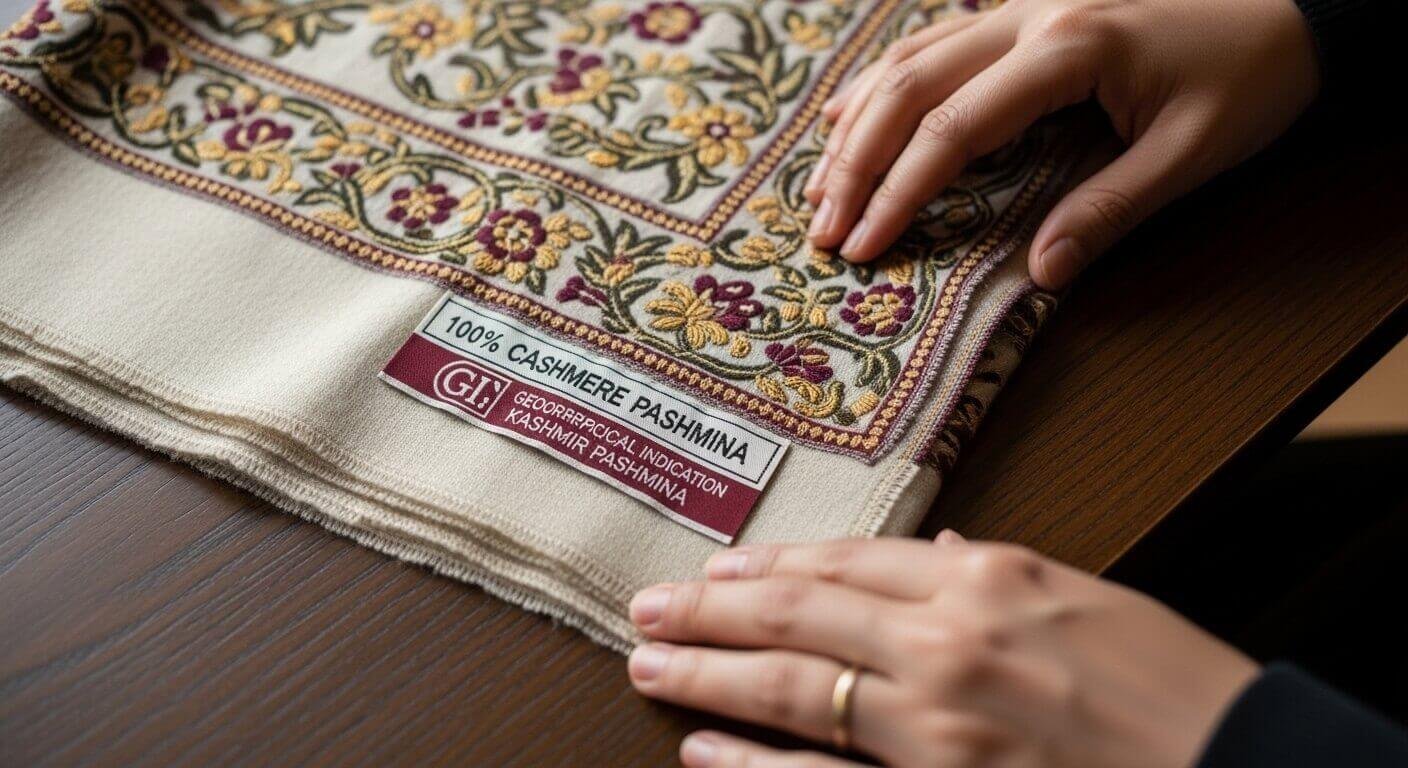
The GI (Geographical Indication) tag is a certification issued by the Indian government through the Craft Development Institute in Srinagar. It officially certifies that:
- The wool was sourced from Changthangi goats of Ladakh
- The spinning was done by hand in Kashmir
- The weaving was done by hand on traditional looms in Kashmir
- The product meets the standard definition of authentic Kashmiri Pashmina
Each GI-tagged shawl comes with a holographic label that has a unique serial number. You can verify that serial number online at the official GI registry.
What the GI tag looks like:
- A small holographic sticker or sewn label on the shawl
- The words “Pashmina” and “GI” are clearly printed
- A unique verification number
- The Craft Development Institute’s mark
Important note: Not every genuine Pashmina has a GI tag. Some small independent artisans work outside the formal certification system. A missing GI tag does not automatically mean the shawl is fake. But a present GI tag provides the strongest possible guarantee. When in doubt, choose GI-tagged pieces from certified sellers.
How to Spot Fake Pashmina When Buying Online
This is where buyers are most vulnerable — and where competitors give the worst advice. Here is what to actually check:
- Check the product title carefully: Words like “Pashmina blend,” “Pashmina-style,” “Pashmina-feel,” or “Pashmina viscose” are legal ways to sell fake Pashmina. These are not genuine Pashmina. They contain little to no real pashm fiber. Only “100% Pashmina” or “100% Cashmere” indicates pure fiber content.
- Read the material composition section, not just the title: Many listings say “Pashmina Shawl” in the title but show “70% viscose, 30% wool” or “100% acrylic” in the product details. Always scroll to the composition.
- Check the seller’s origin and certifications: Genuine Kashmiri Pashmina sellers are based in Kashmir or have verifiable ties to Kashmir artisans. Look for GI certification mentions, Craft Development Institute references, or specific artisan names and workshops. A generic dropship seller in a different country selling “authentic Pashmina” for $25 is not selling authentic Pashmina.
- Price filter is your first shield: Use price as a pre-filter. If it is priced under ₹8,000 in India or under $200 internationally for a full-size shawl, eliminate it without further consideration. Genuine Pashmina cannot be produced at those price points. The goat-combing, hand-spinning, and handweaving alone make it impossible.
- Ask the seller for the micron count: A genuine seller will know the answer: 12 to 16 microns. A fake seller will not understand the question or give a vague answer. This one question filters out 90% of fraudulent sellers online.
Price Guide — What Genuine Pashmina Costs
This is one of the biggest gaps in competitor content. Here is a clear, honest price guide:
| Type of Pashmina | India (₹) | International ($) | Why the Range |
|---|---|---|---|
| Plain, undyed shawl | ₹8,000 – ₹25,000 | $200 – $400 | Basic handweaving, no embroidery |
| Sozni embroidered shawl | ₹25,000 – ₹1,50,000 | $400 – $2,000 | Hand embroidery added, months of work |
| Kani woven shawl | ₹80,000 – ₹5,00,000+ | $1,500 – $8,000+ | Kani patterns woven directly into fabric, years of work |
| Shahtoosh (rare, regulated) | ₹3,00,000+ | $5,000+ | Extremely rare, legally protected — verify carefully |
| Machine-woven genuine cashmere | ₹3,000 – ₹15,000 | $80 – $300 | Genuine fiber, machine-made — still valuable, not handwoven |
| Fake “Pashmina” (viscose/acrylic) | ₹200 – ₹2,000 | $5 – $40 | No real Pashmina fiber at all |
If someone shows you a shawl claiming it is pure handwoven Pashmina for ₹1,500 or $30 — walk away. The price is the fastest lie-detector test in existence.
What to Do If You Already Bought a Fake
You bought a shawl. Now you suspect it is not genuine. Here is what to do:
Do the burn test at home. Pull a thread from the inner fringe where it will not show. Burn it. The smell and residue will tell you immediately.
Check the label again carefully. Does it say “100% Pashmina” or does it say something else? Sometimes the fine print reveals the truth that the title hid.
If confirmed fake, here is your path:
- If bought in India from a certified handicraft store, request a refund citing false labeling. Government-certified stores are held to standards.
- If bought online from a marketplace like Amazon or Etsy, file a return request citing “item not as described.” Most platforms support this.
- If bought as a tourist from a market stall, this is harder to recover from. Use it as a lesson and buy from government emporia or certified stores next time.
The safest places to buy genuine Pashmina in India are government emporiums — the Kashmir Government Arts Emporium in Delhi, Srinagar, and Mumbai. These are not glamorous shopping experiences, but they are completely trustworthy.
Frequently Asked Questions
What is the difference between Pashmina and Cashmere?
They come from different breeds of goat and are separated by fiber thickness. Pashmina comes specifically from the Changthangi goat of Ladakh and measures 12 to 16 microns. Cashmere comes from various cashmere goat breeds across Central Asia and measures 15 to 19 microns. Pashmina is a type of cashmere, but the finest type. Not all cashmere is Pashmina. Both are genuine luxury fibers — but pure Pashmina is rarer and finer.
Can a genuine Pashmina really pass through a wedding ring?
A fine, lightweight plain Pashmina can. This demonstrates how thin the fiber is. However, a heavier embroidered Pashmina or a thicker Kani shawl may not pass through a ring and still be completely genuine. The ring test is a useful indicator but not a definitive proof of authenticity when used alone.
Why does my genuine Pashmina shawl pill?
Pilling is expected with genuine Pashmina. It happens because the ultra-fine fibers are delicate and interlock through use. Use a cashmere comb or a soft-bristled garment brush to gently remove pills. This is a sign of authentic animal fiber — not poor quality.
Is a Pashmina blend worth buying?
A Pashmina-silk blend (typically 70% Pashmina, 30% silk) is a legitimate product with its own qualities — the silk adds sheen and makes the shawl more durable. But it is not pure Pashmina and should not be priced as pure Pashmina. A Pashmina-viscose or Pashmina-polyester blend contains virtually no real pashm fiber and is essentially a synthetic product with a misleading name.
How do I care for a genuine Pashmina shawl?
Hand washes only, in cold water, with a very small amount of mild baby shampoo or specialist wool wash. Never twist or wring it. Roll it gently in a clean towel to remove water. Lay flat to dry in shade — never hang, as it will stretch. Store it folded in a breathable cotton bag. Never use a plastic bag, as moisture can cause fiber damage.
What does a GI tag for Pashmina look like, and where do I find it?
The GI tag for Kashmiri Pashmina is a small holographic sticker or sewn label attached to the shawl. It carries a unique serial number and the official certification mark. You can verify it on the official GI registry of India. Not every genuine artisan piece will carry this tag — some small weavers work outside the formal certification system. But all officially certified pieces will have it, and it is the strongest guarantee of authenticity available.
Is it possible to test Pashmina authenticity at home after buying?
Yes. The burn test is completely reliable at home. Pull a thread from the inner edge of the fringe. Hold it with tweezers. Burn it. Genuine Pashmina smells like burnt hair and leaves soft powdery ash. Synthetic fiber melts, smells like plastic, and leaves a hard residue. This test takes 30 seconds and gives you a definitive answer.
Why is Kashmiri Pashmina specifically more valuable than other regions?
Kashmir has a 600-year tradition of Pashmina weaving. The artisans there have perfected specific techniques — the Sozni hand embroidery, the Kani weave, the Twill weave — that are not replicated at the same level anywhere else. Additionally, the specific combination of the Changthangi goat fiber with the altitude-specific wool characteristics and the traditional spinning and weaving methods of Kashmir produces a quality standard that other regions cannot match.
Final Checklist Before You Buy
Take this with you. Check each point before paying.
- Does it feel impossibly soft and light in your hand?
- Does it weigh under 200 grams for a full shawl?
- Does the fringe look organic and slightly uneven?
- Does it have a matte finish — not shiny or glossy?
- Does the weave show slight irregularities when held up to light?
- Does it produce no static when rubbed against itself?
- Does the label say 100% Pashmina or 100% Cashmere — nothing else?
- Is the price above ₹8,000 in India or above $200 internationally?
- Can the seller tell you the fiber micron count (answer: 12–16)?
- Does the seller allow you to do the burn test on a fringe thread?
- Is there a GI tag, or can the seller provide certification?
If you check yes on 9 or more of these, you are almost certainly looking at the real thing.
Final Word
Genuine Pashmina is one of the most extraordinary natural fibers in the world. It has kept royalty warm for 600 years. It represents the highest level of human craftsmanship — months of skilled, patient work by Kashmiri artisans following traditions passed through generations.
That story is worth protecting. When you buy authentic Pashmina, you support real families and a genuine cultural heritage. When you unknowingly buy a fake, you fund a market that is slowly destroying that heritage.
The tests in this guide are simple, fast, and work every time. Use them confidently. Ask questions without apology. A seller proud of their product welcomes every test you run.