
The Ultimate BlogHyper Guide: From Zero Traffic to First-Page Google
Introduction — Why Most Blogs Never See Page One
93% of all web pages get zero organic traffic from Google. Not a trickle. Zero. And the bloggers behind those pages aren’t lazy or unintelligent — they’re working without the right system.
The gap between a blog that ranks and one that doesn’t isn’t talent. It isn’t the publishing frequency. It isn’t even writing quality, though that matters. The gap is strategic clarity — knowing exactly what to write, how to structure it, and how to signal to Google that your content deserves to be seen.
BlogHyper was built to close that gap. This guide walks you through every step of using it — from initial setup to hitting page one — with zero assumptions about where you’re starting from.
By the end of this article, you’ll have a complete, repeatable system. Not theory. A workflow.
What Is BlogHyper and Why Does It Work?
Most blogging tools solve one problem in isolation. A keyword tool here. An editor there. An analytics dashboard somewhere else. The result is a fragmented workflow where bloggers spend more time switching between platforms than actually writing.
BlogHyper integrates the full content pipeline into one environment. Keyword discovery, content structuring, on-page SEO optimization, and performance tracking live in the same place — connected, informing each decision in real time.
That integration is why it produces results that disconnected tools can’t replicate. When your keyword data directly shapes your content structure, and your content structure is validated against ranking signals before you publish, the entire process becomes intentional rather than hopeful.
The Core Principle Behind BlogHyper’s Effectiveness
Google’s algorithm rewards topical authority — the signal that a site consistently covers a subject with depth and precision. BlogHyper’s architecture is designed around building this authority systematically. Every feature — from its keyword clustering to its internal linking suggestions — is aimed at making your blog look like the most authoritative source in your niche.
That’s not a marketing claim. It’s a reflection of how modern SEO actually works.
Step 1 — Set Up BlogHyper the Right Way From Day One

Setup mistakes compound. A blog configured without a clear niche focus will generate scattered content that ranks for nothing. BlogHyper’s onboarding is designed to prevent exactly this — but only if you engage with it deliberately rather than clicking through to get to the “real” features.
Define Your Niche Focus Before You Touch a Single Feature
The single most valuable action in BlogHyper’s setup phase is niche definition. Not your blog’s name. Not your design. Your topical territory. Be specific. “Fitness” is not a niche. “Strength training for women over 40” is a niche. BlogHyper’s content recommendations become dramatically more precise when the niche input is precise.
Connect Your Domain and Existing Content
If your blog already has posts published — even ones with zero traffic — connect your domain during setup. BlogHyper will audit your existing content, identify optimization opportunities, and flag structural issues that are actively suppressing your rankings.
This audit is one of BlogHyper’s most underused features. Most users skip straight to new content creation. The bloggers who see the fastest early results almost always start with fixing what already exists.
Configure Your Target Audience and Competitors
BlogHyper uses your audience and competitor inputs to calibrate its keyword difficulty scores and content gap analysis to your specific context — not the industry average. A keyword that’s “hard” for a new blog in a competitive niche might be “medium” for a blog with existing domain authority. Accurate inputs produce accurate guidance.
Step 2 — Use BlogHyper for Keyword Research That Actually Ranks
Keyword research done wrong is the single biggest reason blogs stay invisible. Most beginner bloggers target keywords that are either too competitive to rank for or too obscure to generate meaningful traffic. BlogHyper’s keyword research layer is built to find the exact middle ground — high-intent, low-competition keywords with real search volume.
The Keyword Trifecta: Intent + Volume + Difficulty
Every keyword you target should pass a three-part test:
- Intent match — Does the searcher’s goal align with what your post delivers?
- Volume reality — Is the monthly search volume worth the investment of a full post?
- Difficulty honesty — Given your current domain authority, can you realistically rank in the top 10?
BlogHyper scores each keyword against all three dimensions simultaneously. This matters because most standalone keyword tools only show volume and difficulty — stripping out the intent signal that determines whether ranking traffic actually converts to readers.
Keyword Clustering: The Strategy That Builds Topical Authority Fast
One of BlogHyper’s most powerful features is keyword clustering — grouping semantically related keywords into topic clusters that feed a pillar-and-spoke content structure.
Here’s why this works: Google doesn’t rank individual pages in isolation. It evaluates the depth of a site’s coverage across a topic. A site with fifteen tightly interconnected posts about a subject signals more authority than a site with one excellent post and nothing else supporting it.
BlogHyper generates these clusters automatically from your niche inputs. Your job is to publish systematically through them — not cherry-pick the highest-volume keywords and ignore the connective tissue.
Long-Tail First: The Counter-Intuitive Path to Page One
New blogs with zero domain authority cannot rank for short, competitive head terms. This is a mathematical reality, not a motivation problem. A post targeting “weight loss” from a new blog will never see page one, regardless of its quality.
The path to first-page rankings from zero always runs through long-tail keywords — specific, lower-competition phrases that real people search with clear intent. BlogHyper surfaces these automatically, prioritized by their potential to drive early traffic and build the authority that makes broader terms rankable over time.
Step 3 — Write and Optimize Posts With BlogHyper’s Content Engine

Research without execution is a strategy document, not a blog. BlogHyper’s content engine is where keyword intelligence becomes published content — and where most of the ranking work actually happens.
Structure Before You Write — Every Time
The biggest mistake bloggers make in the drafting phase is writing first and structuring after. BlogHyper reverses this. Before a single paragraph is written, its content engine generates a recommended structure: which H2s to include, what subtopics to cover, how long each section should be, and which semantic terms to incorporate.
Following this structure isn’t a creative constraint. It’s a ranking signal. Google’s content evaluation systems assess whether a piece covers a topic completely — and “completely” is defined by what the top-ranking pages already cover, plus the gaps they leave open. BlogHyper maps both.
On-Page Optimization: What Actually Moves Rankings
On-page SEO is not about keyword density. That mental model is fifteen years out of date. Modern on-page optimization — the kind BlogHyper is built around — focuses on:
- Semantic completeness: covering the related terms and entities that Google associates with your target keyword
- Structural clarity: using headers that match search intent and create a logical reading path
- Internal linking: connecting new posts to existing content in ways that distribute authority and keep readers engaged
- Readability signals: sentence length, paragraph density, and formatting choices that reduce bounce rate
BlogHyper scores each post against these dimensions in real time as you write. The score is not a vanity metric — it is a direct proxy for how completely the post satisfies Google’s evaluation criteria.
The Editing Pass Nobody Skips
Before publishing, run every post through BlogHyper’s optimization checklist. This pass catches the issues that kill otherwise strong content: missing internal links, headers that don’t match search intent, thin sections that signal low quality to crawlers, and meta descriptions that don’t include the target keyword.
Five minutes on this checklist before hitting publish has more impact on rankings than an extra hour of writing.
Step 4 — Build a Publishing Strategy That Compounds Over Time
Individual posts don’t build blogs. Systems do. The bloggers who reach first-page rankings consistently are not the ones who publish sporadically whenever inspiration strikes. They publish on a cadence, within a topic cluster structure, with each post deliberately supporting the ones around it.
Consistency Beats Volume Every Time
Publishing two well-optimized, strategically targeted posts per week outperforms publishing seven undirected posts. BlogHyper’s content calendar feature is built around this reality — helping you plan a realistic, sustainable publishing schedule across your keyword clusters.
The compounding effect of consistent, structured publishing is the most underappreciated mechanic in SEO. Each post builds on the authority of the last. Each internal link strengthens the cluster. Each new piece signals to Google that your site is active, authoritative, and deepening its coverage of the topic.
Pillar Posts vs. Supporting Posts — Know the Difference
Not all posts serve the same purpose. BlogHyper distinguishes between:
- Pillar posts — comprehensive, high-word-count pieces targeting your most important keywords, designed to rank and earn backlinks
- Supporting posts — focused, specific pieces targeting long-tail variations, designed to feed authority back to the pillar through internal links
Publishing without this distinction is like building a house without a foundation. You accumulate content, but nothing supports anything else. BlogHyper’s cluster view makes this architecture visible — so every post you publish has a defined role in the larger structure.
Step 5 — Track, Measure, and Iterate Using BlogHyper’s Analytics
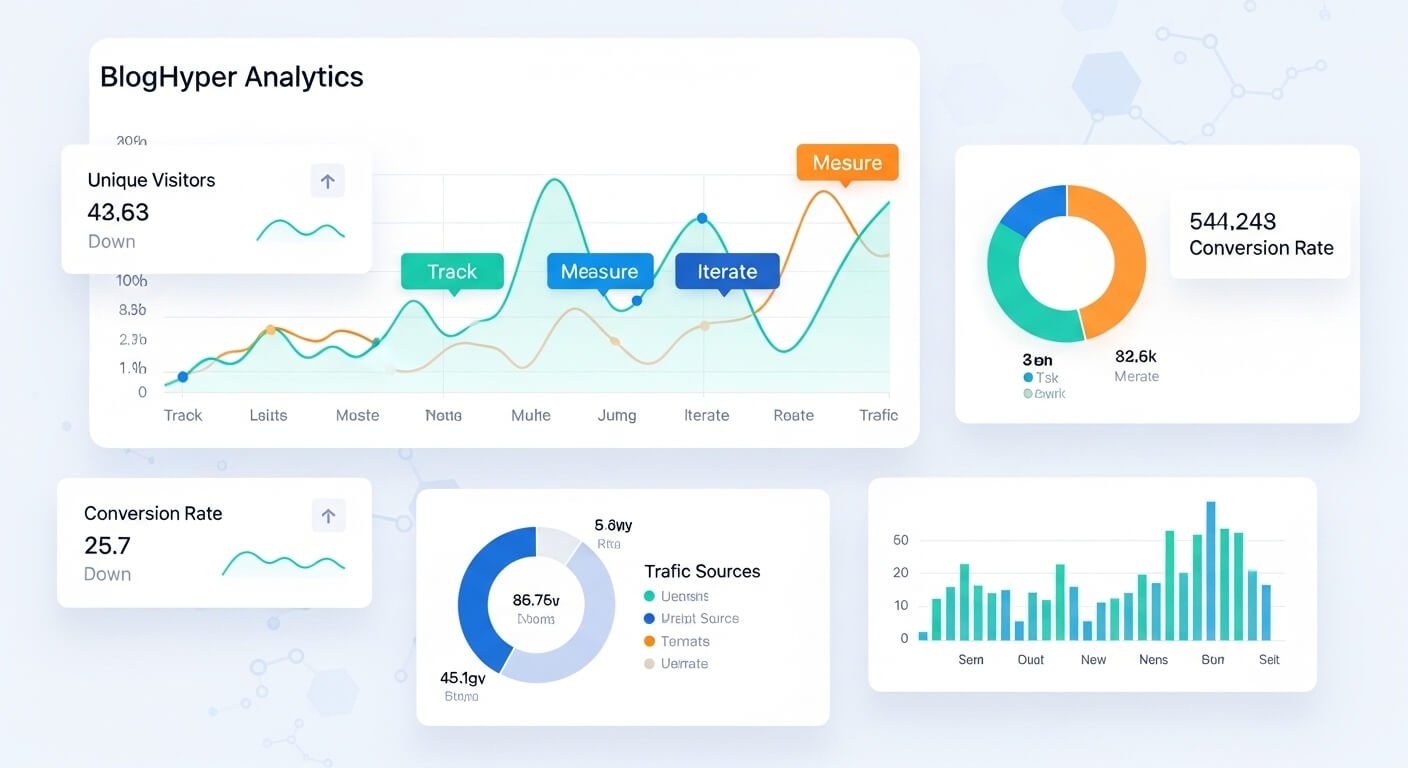
Publishing is not the finish line. For every post that doesn’t reach page one immediately — which, at the start, is most of them — there is a gap between current performance and target performance. BlogHyper’s analytics layer exists to identify and close that gap.
The Metrics That Actually Predict Rankings
Vanity metrics — total page views, social shares, comment counts — feel good and predict nothing. The metrics that correlate with ranking improvement are:
- Average position — where your post currently ranks for its target keyword
- Click-through rate — what percentage of people who see your result actually click it
- Dwell time and bounce rate — whether readers find what they came for
- Crawl coverage — whether Google is indexing your new content promptly
BlogHyper surfaces all four in a single dashboard, mapped to the specific posts and keywords they apply to.
When to Update vs. When to Replace
Not every underperforming post needs to be rewritten from scratch. BlogHyper’s performance view distinguishes between posts that need a targeted update — adding a section, refreshing statistics, strengthening internal links — and posts that are fundamentally misaligned with search intent and need to be rebuilt.
This distinction saves enormous time and prevents the common mistake of abandoning posts that are three good edits away from ranking.
How Long Does It Take to See Results With BlogHyper?
This is the question every new user asks — and deserves a direct answer rather than the vague “it depends” that fills most SEO content.
For a new blog using BlogHyper’s full system — correct setup, targeted keyword clusters, consistent publishing, on-page optimization — the realistic timeline looks like this:
- Weeks 1–4: Content indexed, initial impressions appearing, zero significant traffic
- Weeks 5–12: Long-tail posts begin generating organic clicks; first rankings in positions 11–30
- Months 3–6: Cluster authority builds; targeted posts move into top 10; first first-page rankings appear
- Months 6–12: Compounding effect accelerates; pillar posts gain authority; organic traffic becomes consistent and predictable
These timelines assume two to three optimized posts published per week. They compress with higher publishing frequency and more aggressive link-building. They extend with inconsistent publishing or poor keyword targeting.
The bloggers who see results fastest are not the ones who use BlogHyper the hardest for two weeks and then disappear. They are the ones who use it consistently, methodically, and without expecting shortcuts that don’t exist.
BlogHyper for Beginners vs. Advanced Bloggers — What Changes?
BlogHyper serves both audiences, but the way each should use it differs significantly.
For Beginners
Start narrow. Use BlogHyper’s niche definition tools to find a sub-niche with genuine search demand and manageable competition. Publish exclusively within your keyword clusters for the first three months. Ignore metrics for the first sixty days — they will be discouraging, and they will be temporary. Focus entirely on the process: research, structure, write, optimize, publish, repeat.
The temptation to broaden your topics early is the single most common mistake BlogHyper’s beginner users make. Resist it.
For Advanced Bloggers
If you have an existing blog with content already published, BlogHyper’s content audit is your highest-leverage starting point. Before adding a single new post, identify which existing posts are ranking in positions 11–20 — one targeted update to these posts will produce faster ranking gains than ten new posts targeting fresh keywords.
Advanced users should also use BlogHyper’s competitor gap analysis aggressively. Find topics your competitors rank for that you don’t cover. Build the cluster. Capture the traffic they’re currently owning.
FAQs
What is BlogHyper and how does it work?
BlogHyper is an integrated blogging and SEO platform that combines keyword research, content optimization, publishing strategy, and performance analytics in one workflow. Instead of using separate tools for each stage of content creation, bloggers use BlogHyper to manage the entire process — from finding the right keywords to tracking which posts are approaching first-page rankings and what they need to get there.
Is BlogHyper good for complete beginners with no SEO experience?
Yes — and it’s specifically designed to remove the learning curve that stops most beginners from applying SEO correctly. BlogHyper’s recommendations are actionable rather than technical. It tells you what to do, in what order, with enough context to understand why. You don’t need to know what domain authority or topical clustering means before you start — the platform teaches through use.
How is BlogHyper different from tools like Ahrefs or Semrush?
Ahrefs and Semrush are research tools built for SEO professionals who already know how to translate data into strategy. BlogHyper is a complete blogging system built for content creators who want to rank without becoming SEO specialists. The difference isn’t power — it’s integration and workflow. BlogHyper connects research to writing to publishing to tracking in one environment. The other tools require you to build that connection yourself.
Can BlogHyper help a niche blog with a small audience?
Niche blogs are precisely where BlogHyper performs best. Smaller, tightly defined niches have lower keyword difficulty, more achievable topical authority goals, and more engaged audiences once traffic arrives. A niche blog using BlogHyper’s cluster strategy can reach first-page rankings significantly faster than a broad blog targeting competitive head terms — and the traffic it earns converts at a higher rate.
Does BlogHyper work for blogs outside the US?
BlogHyper supports multilingual and multi-region keyword research, making it effective for bloggers targeting audiences in any major language market. The core SEO principles — topical authority, semantic completeness, internal linking architecture — apply universally. Region-specific search behavior is accounted for in keyword difficulty and volume estimates when the target region is set correctly during setup.
How many posts do I need before BlogHyper starts showing results?
There is no minimum post count — results begin as soon as properly optimized content is indexed. That said, the compounding effect of BlogHyper’s cluster strategy becomes measurable around the 15–20 post mark within a defined cluster. Before that threshold, you are building the foundation. After it, you begin to see the authority gains that accelerate individual post rankings across the entire cluster.
Conclusion: The System Is the Shortcut
There is no magic keyword. No publishing frequency automatically triggers Google’s favor. There is no single BlogHyper feature that transforms a struggling blog overnight.
What transforms a blog is a system — one where every decision is informed by data, every post serves a structural purpose, and every publishing action compounds the one before it.
Three things determine whether BlogHyper works for you: starting with precise niche and keyword targeting, publishing consistently within topic clusters, and treating optimization as an ongoing process rather than a pre-launch checklist.
BlogHyper provides the architecture. The results come from executing inside it — methodically, patiently, and without looking for shortcuts that bypass the process.