How to Identify If the Pashmina Shawl I Am Buying Is Genuine — 7 Tests That Never Lie
Introduction
Over 70% of shawls sold as “pure pashmina” in tourist markets, online platforms, and even reputable-looking stores contain zero actual Pashmina fiber. That number comes from textile trade investigations across Kashmiri markets and is backed by GI authority findings.
If you are standing in a shop right now, or about to click “buy” online, the vendor has almost certainly told you this shawl is genuine. They all do. The problem is that without knowing exactly how to identify if the pashmina shawl you are buying is genuine, you have no way to tell the difference between a ₹800 acrylic wrap and a ₹18,000 hand-woven Kashmiri original.
This guide gives you 7 field-tested, expert-verified methods — from a simple touch test you can do in 10 seconds to understanding government price benchmarks and GI certification labels. By the end, you will know precisely what genuine pashmina feels, looks, burns, and costs — and you will never overpay for a fake again.
What Makes Pashmina Genuine — and Why Fakes Are Everywhere
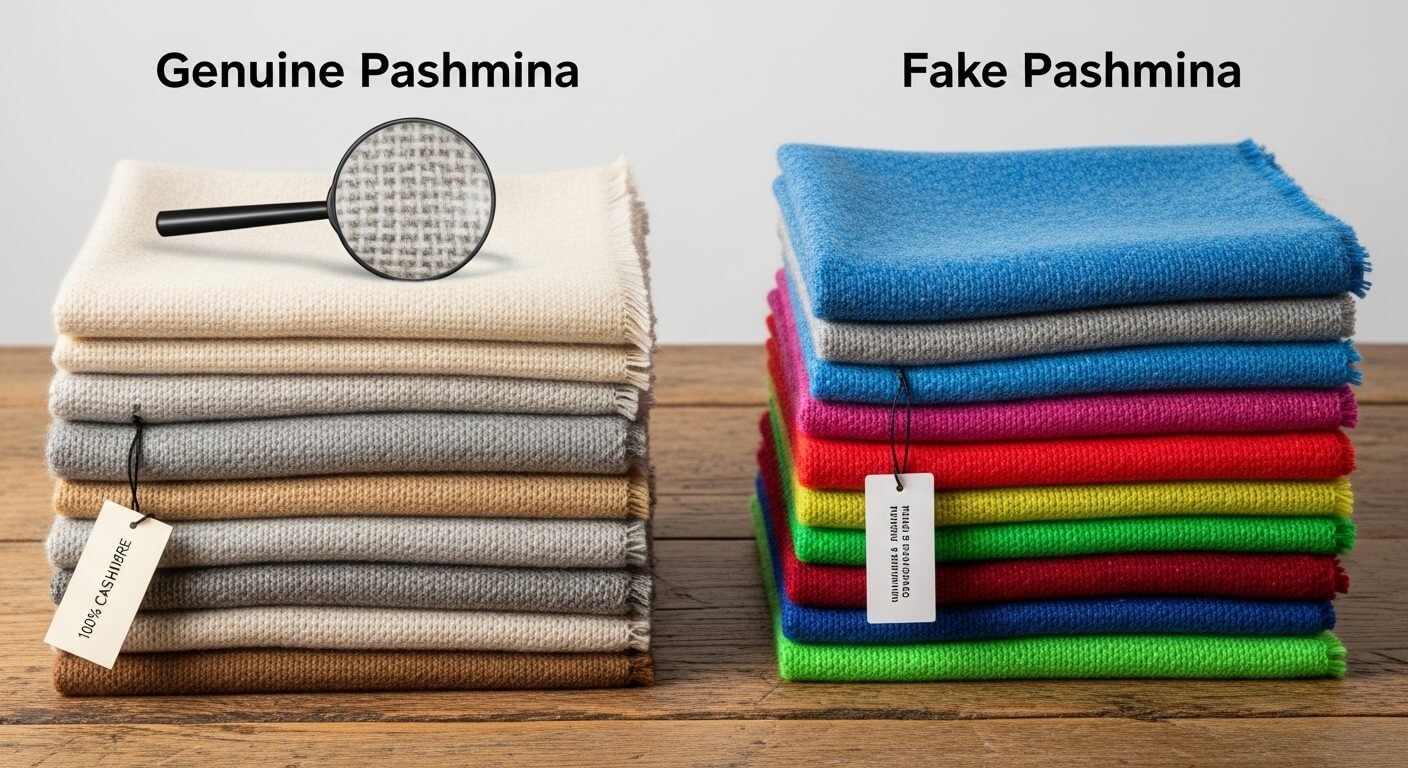
Genuine pashmina comes from one specific source: the undercoat fiber of the Changthangi goat, bred at altitudes above 14,000 feet in the Changthang plateau of Ladakh. The fiber diameter measures between 12–16 microns — finer than the finest merino wool (17–19 microns) and roughly one-sixth the diameter of human hair.
That extreme fineness is what makes real pashmina impossibly soft, genuinely warm, and genuinely expensive to produce. A single Changthangi goat yields only 80–170 grams of raw fiber per year. A standard shawl requires approximately 200–300 grams. The math alone explains why authentic pashmina commands serious prices.
Fakes exist because the word “pashmina” has no legal protection outside of GI-certified products in India. Any vendor anywhere in the world can stitch a “pashmina” label onto an acrylic or viscose shawl and sell it legally in most markets. This is the environment you are buying into.
How to Identify If the Pashmina Shawl I Am Buying Is Genuine: The 7 Tests
Test 1: The Hand Feel Test
Hold the shawl in both hands and press it gently between your palms. Genuine pashmina produces an immediate sensation of warmth without weight. The fiber traps body heat almost instantly — you will feel your palms warming within 5–8 seconds.
Equally important: when you scrunch a genuine pashmina in your fist and release it, it falls back naturally with minimal creasing. Synthetic alternatives spring back stiffly or stay creased.
The texture is not just soft — it is consistently soft across the entire surface. Run your fingers from fringe to fringe. Any roughness, texture variation, or scratching sensation indicates synthetic or wool blending.
Test 2: The Ring Test
This is the most visually dramatic test and genuinely reliable when performed correctly. Take the shawl and attempt to pass it entirely through a standard finger ring (size 7–8 is ideal).
A genuine pashmina shawl — even a full-size 200cm x 70cm piece — passes through a ring completely due to the extreme fineness of the fiber. This works because real pashmina compresses to almost nothing under gentle pressure.
A shawl that bunches, catches, or refuses to pass through is either a wool blend or fully synthetic. Pure wool shawls fail this test. Acrylic shawls fail emphatically. This test takes 15 seconds and requires nothing but the ring on your finger.
Test 3: The Burn Test
Ask the seller for a single loose thread from the fringe — any legitimate seller of genuine pashmina will not refuse this. Light the thread with a match or lighter.
Genuine pashmina burns like human hair: it chars slowly, self-extinguishes when the flame is removed, produces a fine grey ash that crumbles between fingers, and emits a distinct smell of burning protein — similar to singed hair or keratin.
Fake pashmina burns differently in every case:
- Acrylic melts, produces black smoke, smells of chemicals, and leaves hard plastic residue
- Viscose burns fast with a papery smell and leaves almost no ash
- Wool blends burn similarly to pashmina but faster and with coarser ash
If the seller refuses to provide a single thread for burning, that refusal is itself diagnostic information. <<CITE: Textile Research Journal — fiber combustion identification>>
Test 4: The Pilling Test
Rub a small section of the shawl vigorously between your thumb and forefinger for 20–30 seconds. Genuine pashmina will produce very small, fine pills — this is normal and expected due to the short staple length of the fiber. The pills remain fine and soft.
Synthetic shawls either pill heavily and unevenly with coarse balls, or don’t pill at all because the plastic fibers are too smooth. Wool blends pill coarsely.
Fine, soft pilling is not a defect in genuine pashmina — it is a quality indicator. Any seller who uses pilling as proof of fakeness does not understand the fiber they claim to be selling.
Test 5: The Price Test — Real Pashmina Shawl Price Benchmarks
Price is not proof of genuineness, but a price below certain thresholds is proof of fakeness. This is the most overlooked test and the most powerful one to use immediately.
Here are reliable market benchmarks:
| Type | Minimum Genuine Price (India) | Approximate USD |
|---|---|---|
| Plain hand-woven pashmina | ₹8,000 – ₹12,000 | $95 – $145 |
| Embroidered pashmina (sozni) | ₹15,000 – ₹45,000+ | $180 – $540+ |
| Kani woven pashmina | ₹25,000 – ₹1,50,000+ | $300 – $1,800+ |
| Pure pashmina stole | ₹4,000 – ₹8,000 | $48 – $95 |
A shawl sold as “pure pashmina” for ₹1,500 or ₹2,000 is mathematically impossible to be genuine. The raw fiber cost alone exceeds that price. If the price seems too good — it is not a bargain. It is a different product being sold under a false label.
Test 6: The Label and GI Certification Test
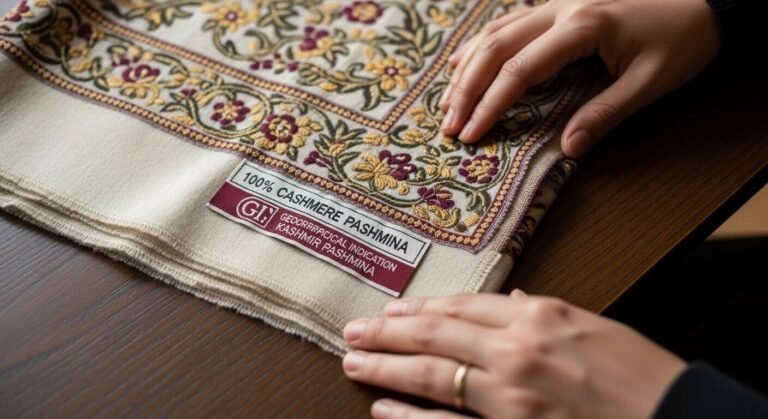
India’s Geographical Indication (GI) tag for Kashmiri pashmina is the most reliable official authentication available. Since 2008, authentic Kashmiri pashmina has been eligible for GI certification under the Geographical Indications of Goods Act. <<CITE: GI Registry India — Kashmiri Pashmina GI Tag>>
Certified products carry a Pashmina Mark — a holographic label issued by the Craft Development Institute (CDI), Srinagar. The label includes:
- A unique serial number
- The CDI logo
- QR code verifiable on the CDI portal
- The words “Handmade in Kashmir.”
What a fake pashmina label looks like: Generic printed tags stating “100% Pure Pashmina” with no hologram, no serial number, no QR code, and no issuing authority name. These labels cost fractions of a rupee to print and are attached to fully synthetic shawls daily across tourist markets.
The presence of a Pashmina Mark does not guarantee authenticity in every case — counterfeit marks exist — but the absence of any GI marking on a shawl sold as Kashmiri pashmina is definitive evidence it is not certified authentic.
Test 7: How to Identify Pure Pashmina Shawl Online
Buying pashmina online removes the ability to perform physical tests, which is precisely why online fraud in this category is even more prevalent than in-person fraud.
When buying online, apply this verification framework:
Check seller credentials first:
- Is the seller registered with the Craft Development Institute or the J&K government portals?
- Does the listing include the GI tag hologram image and serial number?
- Are product images clearly hand-photographed (not stock images)?
Analyze the listing critically:
- Price below ₹6,000 for a full shawl = not genuine, regardless of description
- “Pashmina feel” or “pashmina-like” in the description = explicit admission it is not genuine
- No fiber content percentage listed = red flag
Request before purchasing:
- Ask the seller directly: “What is the micron count of the fiber?”
- A genuine pashmina seller knows the answer immediately: 12–16 microns
- A fake seller will deflect, become vague, or not respond
What Does a Fake Pashmina Label Look Like?
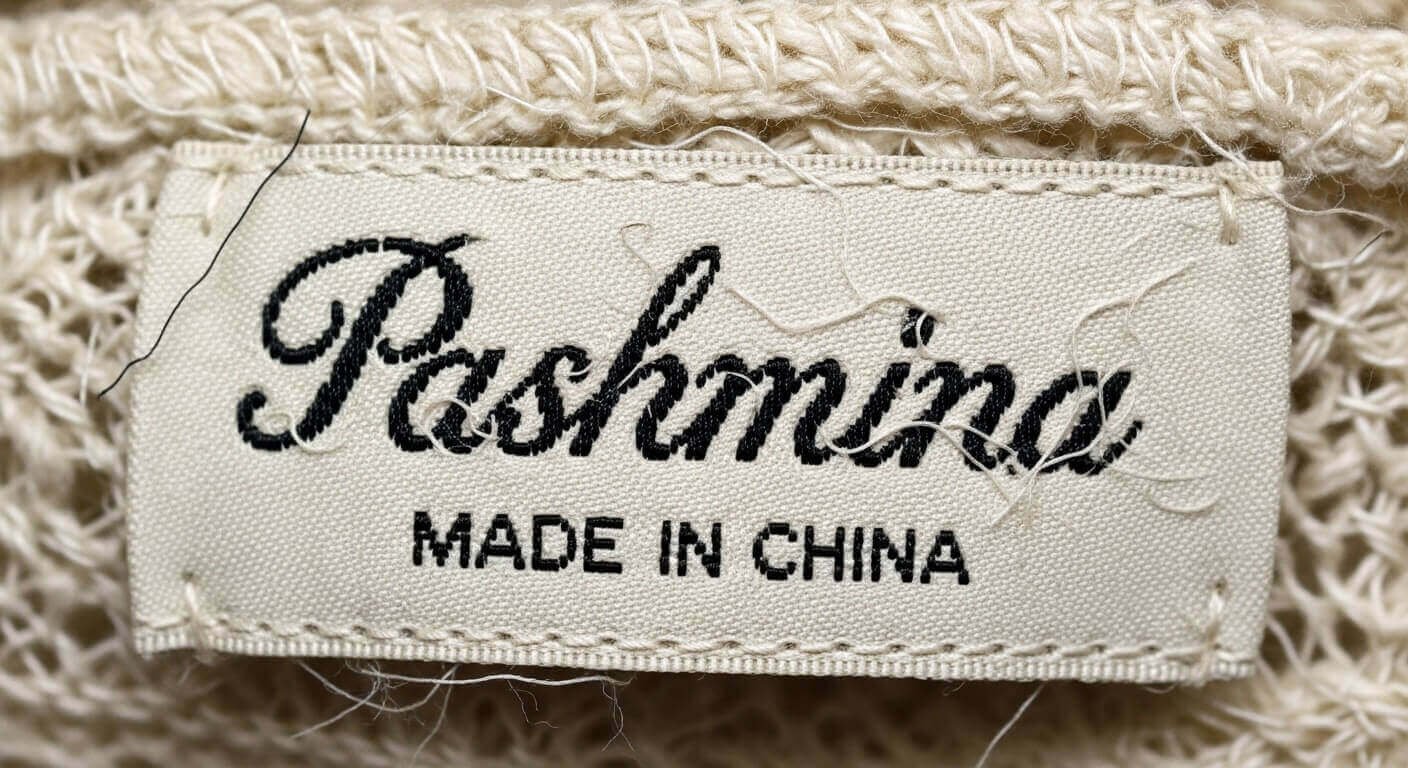
A fake pashmina label is almost always a simple printed tag with bold claims and zero verifiable information. The language is typically maximalist: “100% Pure Original Kashmiri Pashmina — Finest Quality.”
What fake labels never include:
- A holographic security element
- A unique serial number
- Any issuing authority (CDI, GI Registry, J&K Handicrafts)
- A QR code linking to a verification portal
- Fiber micron count or origin certification
The psychological trick sellers use is label confidence — a well-printed, professional-looking tag signals authenticity to buyers who don’t know what genuine certification looks like. Now you know. A confident label with zero verifiable details is a red flag, not a green one.
Pashmina Shawl Government Price — What You Should Actually Pay
The Indian government, through the Craft Development Institute (CDI) Srinagar and the J&K Handicrafts Corporation, periodically issues fair-price guidelines for authentic Kashmiri handicrafts including pashmina. These serve as consumer protection benchmarks.
For reference, government emporia and CDI outlets in Srinagar sell:
- Plain pashmina shawl: ₹9,000 – ₹14,000
- Sozni embroidered shawl: ₹18,000 – ₹60,000+
- Kani pashmina shawl: ₹30,000 – ₹2,00,000+
These prices reflect fair artisan wages, genuine fiber costs, and the extraordinary labor involved. A single Kani pashmina shawl requires 18 months to 3 years of weaving time by master craftspeople.
The existence of government pricing serves one critical function for buyers: it establishes a floor below which genuine pashmina cannot exist. Any vendor offering prices dramatically below these benchmarks is either selling a blend, a fake, or operating at an unsustainable loss that should itself raise questions.
Original Kashmiri Shawl — How to Identify the Real Thing
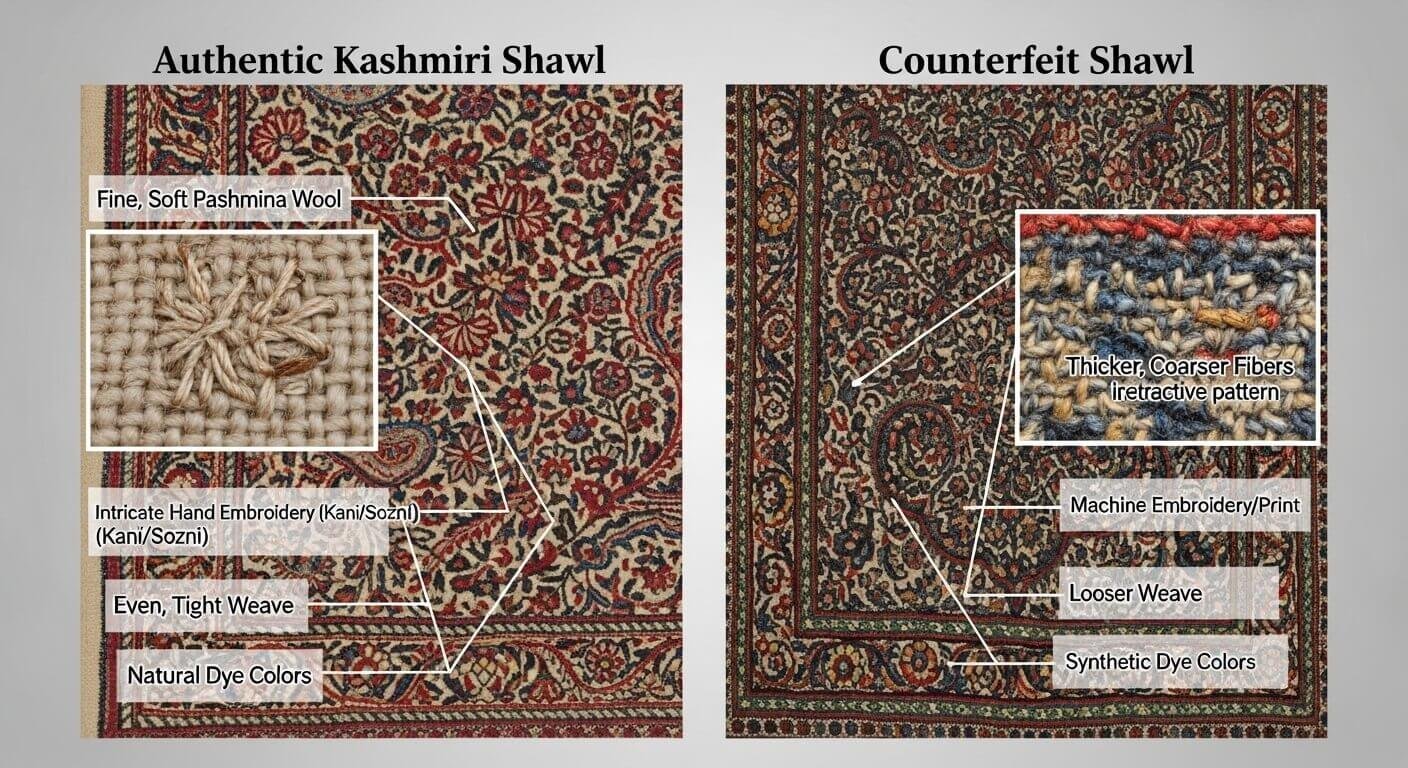
An original Kashmiri shawl is not simply any shawl made in Kashmir. It refers specifically to hand-woven or hand-embroidered shawls produced using traditional techniques — kani weaving, sozni embroidery, or namda work — by artisans who have trained for years under the Kashmiri craft tradition.
Three markers distinguish an original Kashmiri shawl from imitations:
1. Weave irregularities under close inspection. Hand-woven products show microscopic variations in thread tension and pattern alignment. Machine-made replicas are perfectly uniform, which sounds like a positive but is the opposite of authentic handcraft.
2. Reverse side of embroidery. On a genuine sozni-embroidered Kashmiri shawl, the reverse side shows the mirror pattern of the front — slightly rougher but clearly formed. Machine embroidery shows floating threads, skipped stitches, and backing material on the reverse.
3. Weight and drape. A genuine Kashmiri pashmina shawl weighs between 100–200 grams for a standard size. It drapes with a fluid, almost liquid quality. Heavier shawls contain wool blends; shawls that feel plasticky contain synthetics.
What to Say to the Seller (Scripts That Work)
Most buyers hesitate to test shawls in shops because they fear offending the seller. Here is the reality: a genuine pashmina seller expects and welcomes verification. A seller who becomes defensive when you ask to test is protecting a deception, not a relationship.
Use these exact phrases:
- For the burn test: “I’d like a single thread from the fringe to test the fiber. This is standard practice for pashmina verification — do you mind?”
- For the price question: “Can you show me the CDI Pashmina Mark and the GI certification on this piece?”
- For online sellers: “What is the micron count of the pashmina fiber in this shawl, and can you share the GI tag serial number?”
- A seller who cannot answer these questions confidently is not selling genuine pashmina. Walk away. The inconvenience of leaving is infinitely smaller than the cost of buying a fake.
Conclusion
Knowing how to identify if the pashmina shawl you are buying is genuine comes down to three non-negotiable principles. First, test the fiber physically — the hand feel, ring test, and burn test together are nearly impossible to fake simultaneously. Second, know your price floor — genuine pashmina below ₹8,000 for a full shawl does not exist, regardless of what any seller tells you. Third, demand certification — the CDI Pashmina Mark and GI tag are your only official proof of authenticity, and their absence is your answer.
You now have the same verification framework that textile experts use. Apply it every time, without apology.
Your next step: before your next purchase, save the government price benchmarks and CDI certification details from this guide. Walk in informed, test without hesitation, and buy only what passes every check.
<<INTERNAL LINK: where to buy certified pashmina shawls in India>>
FAQs
How do I identify if the pashmina shawl I am buying is genuine?
Perform three tests: the hand feel test (warm, weightless, no scratching), the ring test (full shawl passes through a finger ring), and the burn test (thread burns like hair, self-extinguishes, leaves fine ash). Verify the CDI Pashmina Mark hologram and confirm the price is above ₹8,000 for a full plain shawl. All tests together give near-certain verification.
What is the government price of a genuine pashmina shawl?
Government emporia and CDI-authorized outlets in Srinagar sell plain genuine pashmina shawls between ₹9,000 and ₹14,000. Embroidered sozni shawls begin at ₹18,000, and Kani woven pashmina starts at ₹30,000. These figures represent fair-trade prices for authenticated Kashmiri pashmina and serve as the minimum pricing benchmark for buyers.
How do I identify a pure pashmina shawl when buying online?
Check that the listing includes a GI tag serial number and CDI Pashmina Mark image. Verify the price meets the minimum genuine benchmark (₹6,000+ for a stole, ₹8,000+ for a full shawl). Ask the seller directly for the fiber micron count — genuine pashmina is 12–16 microns. Avoid any listing using “pashmina-feel” or “pashmina-type” language.
What does a fake pashmina label look like?
A fake pashmina label is a printed tag with bold authenticity claims but no hologram, no serial number, no issuing authority name, and no QR verification code. Genuine Kashmiri pashmina carries the CDI Pashmina Mark — a holographic label with a unique traceable serial number. If the label cannot be verified through an official portal, treat it as unverified.
What is the real pashmina shawl price in Kashmir?
In Kashmir’s official government emporia and CDI-authorized outlets, genuine plain pashmina shawls are priced between ₹9,000 and ₹14,000. Tourist market prices below ₹3,000–₹4,000 for “pure pashmina” are categorically fake. The raw Changthangi fiber and hand-weaving labor alone make pricing below ₹8,000 for a full shawl economically impossible for genuine products.
How do I identify an original Kashmiri shawl?
An original Kashmiri shawl shows hand-weave irregularities under close inspection, a mirror embroidery pattern on the reverse side, fluid drape, and weighs 100–200 grams for standard size. It carries the CDI Pashmina Mark and GI certification. Machine-made replicas are perfectly uniform in weave and show floating threads or backing material on the embroidery reverse.
Is the burn test for pashmina actually reliable?
Yes, when performed correctly. Genuine pashmina burns exactly like human hair — slowly, self-extinguishes, leaves fine grey crumbling ash, and smells of burning protein. Acrylic fakes melt and smell chemical. Viscose burns fast with a paper smell. The burn test on a single fringe thread takes 15 seconds and is one of the most definitive field tests available without laboratory equipment.