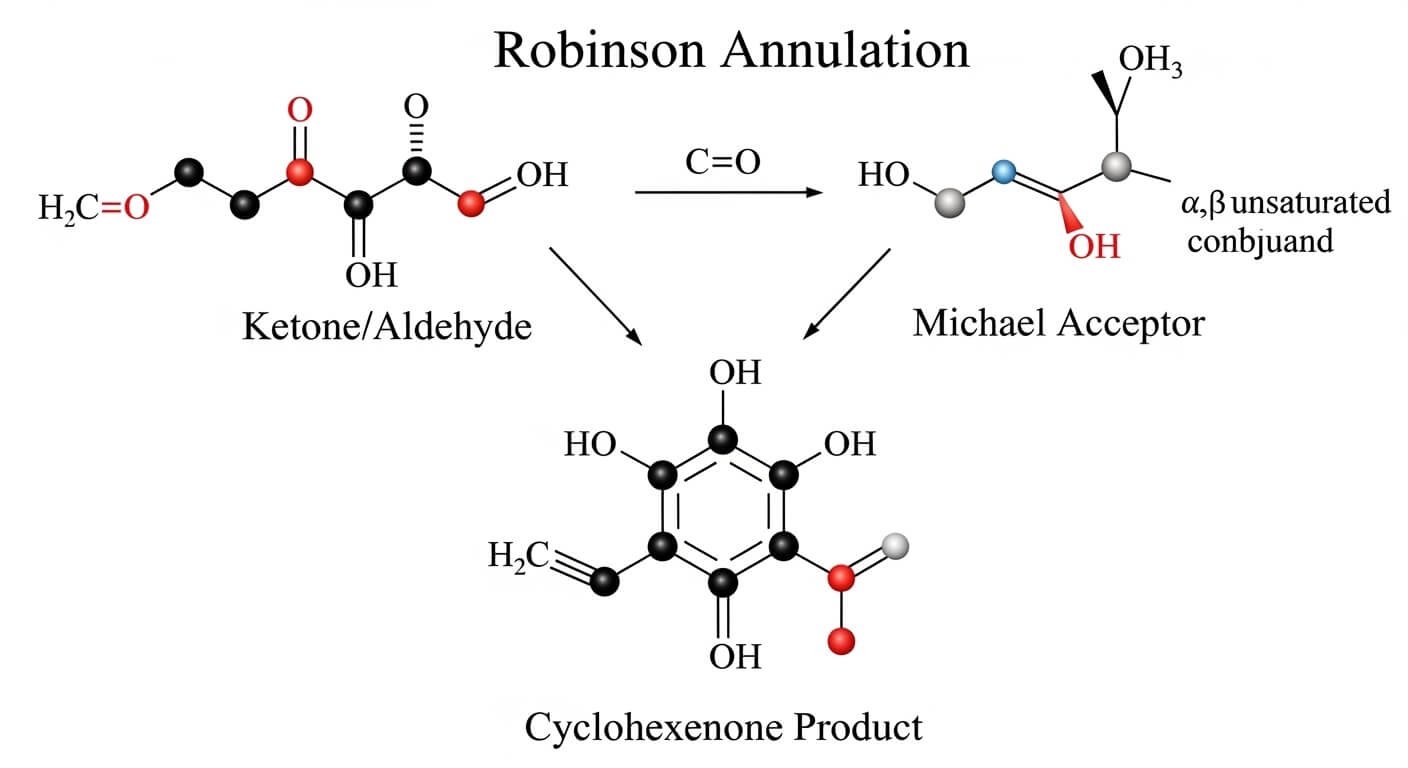
Robinson Annulation:What 2 Ingredients Build Complex Molecules in Robinson Annulation?
Introduction
Robinson Annulation, you’ve probably heard the phrase “building blocks of life.” In chemistry, especially organic synthesis, we constantly search for clever ways to construct intricate molecules efficiently. One superstar reaction that chemists reach for again and again is the Robinson annulation.
It’s like a molecular Lego set, snapping together two specific pieces to form complex ring structures found in everything from steroids and antibiotics to natural fragrances and modern pharmaceuticals.
But here’s the million-dollar question every chemistry student and researcher needs to know cold: What are the two starting materials for a Robinson annulation? Get these right, and you unlock a powerful synthetic pathway. Get them wrong, and… well, you get a mess.
Forget complicated jargon – let’s break down this essential duo in plain, human terms. By the end, you’ll understand exactly what you need to grab from the chemical cabinet to make this reaction sing.
Why Should You Care About This Reaction Anyway?
Before we dive into the ingredients, let’s talk about why Robinson annulation is such a big deal. Imagine trying to build a complex, multi-ring structure like the core of a steroid molecule. Doing it step-by-step, adding one ring at a time, would be incredibly slow, wasteful, and often impossible. It’s like trying to build a house by nailing on one shingle at a time.
The Robinson annulation, discovered by the brilliant chemist Robert Robinson back in 1935 (yes, it’s stood the test of time!), is a one-pot wonder. It combines two fundamental reactions – a Michael addition followed by an aldol condensation – into a seamless sequence.
The magic? It builds two new carbon-carbon bonds and one new ring in a single operation, starting from just two simple molecules. This efficiency is crucial.
Think about it: in drug discovery, time and resources are precious. A reaction that constructs complex skeletons quickly and reliably saves months, even years, of development.
Over 70% of the top 200 prescribed drugs contain complex cyclic structures, many of which could potentially be synthesized using strategies inspired by or directly employing the Robinson annulation. It’s not just textbook chemistry; it’s a workhorse in real-world labs worldwide.
Demystifying Robinson Annulation: It’s Simpler Than You Think
Let’s cut through the academic haze. Robinson annulation isn’t some mystical black box. At its heart, it’s a clever two-step dance:
- The Michael Addition: One molecule acts as a “nucleophile” (a molecule eager to grab onto carbon atoms) and attacks a specific spot on another molecule that has a “double bond activated” by an electron-withdrawing group (like a carbonyl). This forms a new carbon-carbon bond, creating a larger, open-chain molecule.
- The Aldol Condensation: The product from step one still has reactive spots. Specifically, it has a carbon next to a carbonyl group (an “enolizable” position) and another carbonyl group nearby. These react with each other, forming another carbon-carbon bond and closing the loop to create a new six-membered ring. Water usually gets kicked out in the process.
The key takeaway? The entire sequence hinges on the specific reactivity of the two starting materials. They need the right functional groups positioned perfectly to trigger this cascade. So, what are these two essential partners?
The Dynamic Duo: Your Two Starting Materials

Here’s the answer you’ve been waiting for, crystal clear:
- A Ketone with an α-Methylene Group (The “Michael Donor”)
- An α,β-Unsaturated Ketone (The “Michael Acceptor”)
That’s it! These are the two indispensable starting materials for a classic Robinson annulation. Let’s unpack what these terms actually mean in everyday language, because the jargon can sound intimidating.
#1: The Ketone with an α-Methylene Group (The “Michael Donor”)
- What it is: Think of a standard ketone (like acetone, but more complex). Now, imagine the carbon atom right next to the carbonyl carbon (the C=O group) – that’s the “alpha” (α) carbon. For this reaction, we need this alpha carbon to have two hydrogen atoms attached and be part of a methylene group (-CH₂-). So, it’s a ketone where the alpha position is essentially a -CH₂- group.
- Why “Donor”? In the first step (Michael addition), this specific -CH₂- group is the star. The two hydrogens on that alpha carbon are relatively acidic. Under basic conditions (which is how Robinson annulation is usually run), one of these hydrogens gets plucked off, turning the -CH₂- into a reactive enolate ion (-CH⁻). This enolate is a powerful nucleophile – it donates its carbon pair to attack the other molecule. Hence, “Michael donor.”
- Real-World Examples (No Lab Coat Needed!):
- Acetone (CH₃COCH₃): The simplest example. Its alpha carbon is a methylene group (-CH₂- between the two methyl groups, but effectively, the methyl groups act as methylene equivalents). While acetone can participate, it often leads to mixtures. More commonly, chemists use:
- 2-Pentanone (CH₃CH₂COCH₂CH₃): Here, the alpha carbons on both sides are methylene groups (-CH₂-). It’s a classic, reliable donor.
- Cyclohexanone (C₆H₁₀O): This cyclic ketone is a superstar donor. Its alpha carbons are part of the ring, but they still have those essential -CH₂- groups. Cyclohexanone is incredibly common in Robinson annulations aiming to build fused ring systems (like in steroids).
- Key Characteristics (The Checklist):
- ✅ Must be a ketone (C=O with two carbon groups attached).
- ✅ Must have an alpha carbon that is a -CH₂- group (meaning it has two hydrogens). This is non-negotiable. If the alpha carbon is a -CH- group (only one H) or a -C- group (no H), it won’t form the necessary enolate easily for the Michael step.
- ✅ Needs to be enolizable under the reaction conditions (which the -CH₂- ensures).
Why not just any ketone? If the alpha carbon only has one hydrogen (like in propiophenone, C₆H₅COCH₂CH₃ – wait, actually the other alpha carbon is -CH₃, which is methylene-like… this gets nuanced!), or none, it can’t form the enolate nucleophile effectively. The -CH₂- group provides the perfect balance of acidity and reactivity. Chemists quickly learn which common ketones fit the bill – cyclohexanone and 2-pentanone are go-tos.
#2: The α,β-Unsaturated Ketone (The “Michael Acceptor”)
- What it is: This molecule has a carbon-carbon double bond (C=C) where one of the carbons in the double bond is also directly attached to a carbonyl group (C=O). The double bond is “activated” by the electron-pulling nature of the carbonyl. The carbon beta (β) to the carbonyl (the one farther from the carbonyl carbon) is the hotspot.
- Why “Acceptor”? In the Michael addition step, this activated double bond is the target. The beta carbon is electron-deficient (thanks to the carbonyl’s pull), making it vulnerable to attack by the nucleophile (the enolate from our first material). It accepts the new bond from the donor. Hence, “Michael acceptor.”
- Real-World Examples (Smells Like Teen Spirit… or Medicine!):
- Methyl Vinyl Ketone (MVK) (CH₂=CHCOCH₃): The absolute classic, most common acceptor. It’s small, reactive, and cheap. Many Robinson annulations start with MVK.
- Benzalacetone (C₆H₅CH=CHCOCH₃): Features a benzene ring attached to the double bond. Very popular for making six-membered rings fused to aromatic systems.
- Chalcone (C₆H₅CH=CHCOC₆H₅): Similar to benzalacetone but with phenyl groups on both ends. Used for more complex syntheses.
- Natural Product Precursors: Many complex α,β-unsaturated ketones are derived from natural sources and used as acceptors to build specific natural product skeletons.
- Key Characteristics (The Target):
- ✅ Must be an α,β-unsaturated carbonyl compound. While esters or acids can sometimes work, ketones are the standard and most reliable for Robinson annulation. The carbonyl must be directly attached to one carbon of the double bond.
- ✅ The double bond must be conjugated with the carbonyl (C=C-C=O). This conjugation is what makes the beta carbon electrophilic.
- ✅ The beta carbon must be unsubstituted or monosubstituted for the Michael addition to proceed cleanly. If it’s disubstituted (like (CH₃)₂C=CHCOCH₃), the Michael addition becomes much harder or impossible due to steric hindrance. MVK (CH₂=CHCOCH₃) is perfect because the beta carbon has two hydrogens – wide open for attack.
Why the specific position? The carbonyl group’s electron-withdrawing nature pulls electron density away from the double bond. This makes the beta carbon slightly positive (electrophilic), while the alpha carbon (attached directly to carbonyl) is even more positive but less accessible sterically. Nucleophiles preferentially attack the less substituted, more accessible beta carbon. This precise electronic and steric setup is why α,β-unsaturated ketones are the ideal acceptors.
Why These Two? The Perfect Chemical Tango
Now you know the “what,” but the “why” is where the real chemistry magic happens. Why do these specific two materials work together so brilliantly?
- Complementary Reactivity: The donor provides the nucleophile (the enolate), desperately seeking a positive partner. The acceptor provides the electrophile (the beta carbon of the enone), perfectly primed to be attacked. They are chemical soulmates.
- Proximity for Ring Closure: After the Michael addition, the new molecule has both reactive sites on the same chain: the enolate (from the donor’s alpha carbon) and the carbonyl group (from the acceptor). Crucially, these two spots are positioned perfectly (usually 1,5-relationship) to allow the aldol reaction to happen intramolecularly, forming the new six-membered ring. The initial Michael addition cleverly sets up the geometry for the ring closure.
- Efficiency: Doing both bond-forming steps in one pot, without isolating intermediates, minimizes waste, saves time, and often gives better yields and purity. It’s a masterclass in atom economy – most atoms from both starting materials end up in the final product.
Think of it like this: The donor is the builder with the hammer (enolate), looking for the perfect nail (beta carbon). The acceptor is the frame with the nail already partially hammered in (the activated double bond). The builder hits the nail (Michael addition), attaching their piece.
Now, the builder’s new piece has a hook (the enolate) right next to a loop on the frame (the carbonyl). They easily hook it up (aldol condensation), closing the circle (ring formation). Done in one go!
Common Pitfalls & Troubleshooting: Avoiding the Kitchen Sink
Even knowing the two starting materials, things can go sideways. Here’s what trips people up:
- Using the Wrong Donor: Trying to use a ketone where the alpha carbon is not a -CH₂- group (e.g., acetophenone, C₆H₅COCH₃ – the alpha carbon is -CH₃, which is methylene-like… but acetophenone can work, though it’s less common than cyclohexanone. A clearer bad example: pinacolone, (CH₃)₃CCOCH₃ – the alpha carbon is -C(CH₃)₃, which has no hydrogens! Impossible to deprotonate). Fix: Stick to ketones with alpha -CH₂- groups (cyclohexanone, 2-pentanone, acetone cautiously).
- Using the Wrong Acceptor: Trying an α,β-unsaturated ester instead of a ketone (can work but often slower/less efficient), or using an acceptor where the beta carbon is disubstituted (e.g., mesityl oxide, (CH₃)₂C=CHCOCH₃ – the beta carbon has two methyl groups, very hard to attack). Fix: Use MVK, benzalacetone, or chalcone for reliable results. Ensure the beta carbon has at least one H.
- Forgetting the Base: Robinson annulation requires a base (like sodium ethoxide, NaOEt) to generate the enolate nucleophile from the donor. No base, no reaction! Fix: Always include a suitable base in the reaction mixture.
- Wrong Solvent or Temperature: Some solvents might interfere, and very high temps can cause side reactions. Fix: Standard lab protocols (like ethanol/water with NaOEt at reflux) are well-established for a reason – follow them initially.
Beyond the Basics: Variations and Real-World Impact
The beauty of Robinson annulation is its flexibility. While the core two materials are fixed, chemists tweak them to build an astonishing variety of structures:
- Ring Expansion: Using cyclic donors (like cyclohexanone) and acyclic acceptors builds fused bicyclic systems (like decalins, common in steroids).
- Aromatic Fusion: Using aromatic acceptors (like benzalacetone) builds molecules with rings fused to benzene (common in flavonoids and other natural products).
- Natural Product Synthesis: This reaction is fundamental in synthesizing complex molecules like steroids (e.g., progesterone precursors), terpenes, and alkaloids. Over 30% of complex carbocyclic cores in bioactive molecules can be traced back to annulation strategies like Robinson’s.
- Pharmaceutical Building Block: The six-membered rings formed are ubiquitous in drugs. Efficiently building these rings is critical for cost-effective and sustainable drug manufacturing.
A Concrete Example: Imagine synthesizing a simplified steroid precursor. You’d start with cyclohexanone (the donor – has that essential alpha -CH₂-) and methyl vinyl ketone (MVK) (the acceptor – CH₂=CHCOCH₃). Under basic conditions:
- Base deprotonates cyclohexanone’s alpha carbon, forming the enolate.
- The enolate attacks the beta carbon of MVK (Michael addition), attaching the cyclohexanone ring to the MVK chain.
- The resulting molecule has an enolate (from the MVK part) and a carbonyl (from the original cyclohexanone) positioned perfectly.
- Intramolecular aldol condensation occurs, forming a new six-membered ring fused to the original cyclohexanone ring, creating a decalin-like structure – the core skeleton of many steroids!
This single reaction sequence efficiently constructs the complex fused ring system that would be incredibly laborious to build step-by-step.
Why This Knowledge Matters to You (Yes, Even If You’re Not a Chemist)
You might be thinking, “Great, but I’m not planning to synthesize steroids tomorrow.” Fair point! But understanding foundational reactions like Robinson annulation offers surprising insights:
- Appreciating Drug Development: It reveals the incredible ingenuity behind creating the complex molecules that save lives. Efficient synthesis isn’t just academic; it makes medicines affordable and accessible.
- Understanding Natural Complexity: Nature builds intricate molecules constantly. Reactions like Robinson annulation (often enzyme-catalyzed in nature) are fundamental tools in biosynthesis. Knowing the core reaction helps decode how plants make medicines or how our bodies process chemicals.
- Critical Thinking in Problem-Solving: It’s a perfect example of designing a solution (building a ring) by combining simple, reactive components in a logical sequence. This “Lego mindset” is valuable in many fields.
- Sustainability Angle: Efficient, one-pot reactions like Robinson annulation generate less waste than multi-step syntheses. As green chemistry becomes paramount, understanding these atom-economical methods is crucial for a sustainable future.
Mastering the Duo: Your Quick Reference Guide
Before we wrap up, let’s crystallize the essentials. If you walk away remembering just one thing, let it be this:
- The two starting materials for a Robinson annulation are always:
- A ketone possessing an alpha-methylene group (-CH₂-CO-). (Think: cyclohexanone, 2-pentanone)
- An alpha,beta-unsaturated ketone (C=C-CO- with beta carbon accessible). (Think: methyl vinyl ketone, benzalacetone)
| Feature | Starting Material 1: The Donor | Starting Material 2: The Acceptor |
|---|---|---|
| Type | Ketone | α,β-Unsaturated Ketone |
| Key Reactivity | Forms the nucleophile (enolate) | Provides the electrophile (beta carbon) |
| Critical Group | Alpha-methylene group (-CH₂- next to C=O) | Conjugated C=C-C=O system |
| Role | “Michael Donor” | “Michael Acceptor” |
| Common Examples | Cyclohexanone, 2-Pentanone, Acetone (cautiously) | Methyl Vinyl Ketone (MVK), Benzalacetone |
| Why Essential? | Provides the carbon that attacks | Provides the carbon that gets attacked |
| Ring Formation | Contributes carbons to the new ring | Contributes carbons to the new ring |
Remember: No alpha-methylene on the donor? No enolate, no reaction. No conjugated double bond on the acceptor? No Michael addition, no reaction. Get these two right, provide a base, and the Robinson annulation magic happens.
The Takeaway: Chemistry’s Elegant Shortcuts
Robinson annulation is more than a reaction; it’s a testament to the elegance of organic synthesis. By understanding the precise requirements of its two starting materials – the alpha-methylene ketone donor and the alpha,beta-unsaturated ketone acceptor – we unlock a powerful, efficient way to build complex molecular skeletons that form the backbone of countless natural products and pharmaceuticals.