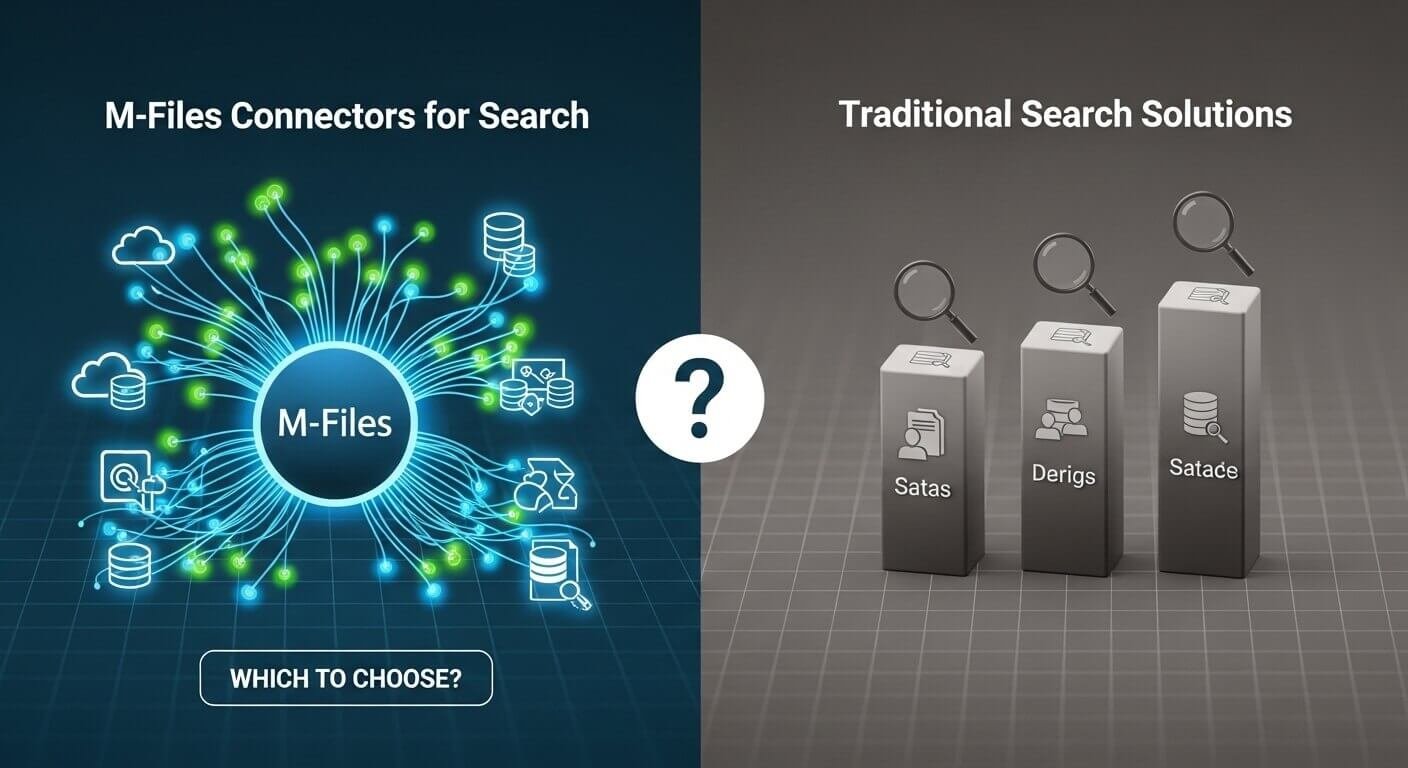
Organizations today are inundated with vast amounts of data, making the efficiency of search solutions more critical than ever. According to IDC, 80% of worldwide data will be unstructured by 2025. This emerging landscape necessitates robust search technologies that go beyond traditional methods to deliver precise, context-driven results for decision-making.
Addressing the complexities of data retrieval in the modern enterprise, M Files connectors for search are gaining ground as a go-to solution. Below, we investigate how these innovative connectors stand against traditional search solutions, illuminating the path for organizations to make informed choices for their search strategies.
M Files Connectors for Search: Enhancing Enterprise Information Retrieval
m files connectors for search M Files connectors for search redefine how enterprises handle information retrieval by offering deep integration with a multitude of content sources. These connectors not only streamline search across various repositories but also provide users with relevant, actionable insights through advanced metadata tagging and indexing capabilities.
The strength of M Files lies in its ability to unify disparate data sets, allowing users to conduct searches as if all information were housed within a single, cohesive system. Furthermore, the connectors intelligently analyze content, delivering search results that reflect the nuances of the user’s intent and the business context.
Organizations considering M Files should look to integrate these connectors with their existing information ecosystems seamlessly. Ensuring compatibility and configuring metadata appropriately can greatly enhance the relevance and accuracy of search results, empowering users to find what they need with unprecedented efficiency.
Traditional Search Solutions: Limitations in Modern Data Environments
While traditional search solutions have served businesses well in the past, they often struggle to keep pace with the evolving complexities of today’s data-intensive environments. Their primary limitation lies in the difficulty in unifying information scattered across different silos, which can result in incomplete or outdated search results.
In addition to these integration challenges, conventional tools typically lack the sophisticated algorithms required to interpret user context or the content’s semantics. This can lead to a significant disconnect between the user’s search intent and the information retrieved, which is often a list of keyword-based results rather than insightful answers.
For organizations leveraging traditional search solutions, it’s advisable to conduct a thorough analysis of their current data architecture and user demands. Identifying these limitations can help in making critical decisions on whether to upgrade to more advanced search technologies capable of handling the full spectrum of enterprise data.
Comparing Performance: M Files Connectors vs Traditional Search Methods
The performance of M Files connectors in contrast to traditional search methods speaks volumes about the efficacy of modern search solutions. Users typically report not only faster retrieval times with M Files but also a significant improvement in the relevance of search results due to its intelligent data processing features.
Metrics such as accuracy, speed, and user satisfaction are markedly higher with M Files search connectors, stemming from customized indexing and the system’s innate understanding of content relationships. This translates to direct productivity gains, as employees spend less time searching and more time utilizing the information.
When benchmarking search performance, organizations should consider their unique informational landscape. Through comprehensive evaluations and real-world tests, decision-makers can observe firsthand how M Files connectors elevate search capabilities to meet their enterprise’s specific needs.
Making the Right Choice for Your Organization’s Search Needs
Selecting the right search solution hinges on a nuanced understanding of an organization’s current and future data management requirements. M Files connectors offer a forward-thinking approach that aligns with the trend of increasing data complexity and the need for more intelligent and integrated search capabilities.
To make an informed decision, it’s essential to assess factors such as the scope of data sources, the expected growth in data volume, and the particular search behavior of the user base. The adaptability and scalability of the chosen solution are key, ensuring it can evolve alongside the organization’s information landscape.
Engaging with stakeholders, including IT professionals and end-users, to gather diverse perspectives on search needs can further aid in selecting a suitable enterprise search solution. Careful consideration of these factors ensures that organizations are equipped with powerful tools for navigating the data deluge effectively.
Overall, the choice between M Files connectors for search and traditional search solutions is a function of an organization’s commitment to future-proofing its data retrieval processes. Through careful analysis and a willingness to embrace innovative technologies, enterprises can harness the full potential of their information resources, ensuring streamlined access and strategic insights that drive success in an increasingly data-driven world.