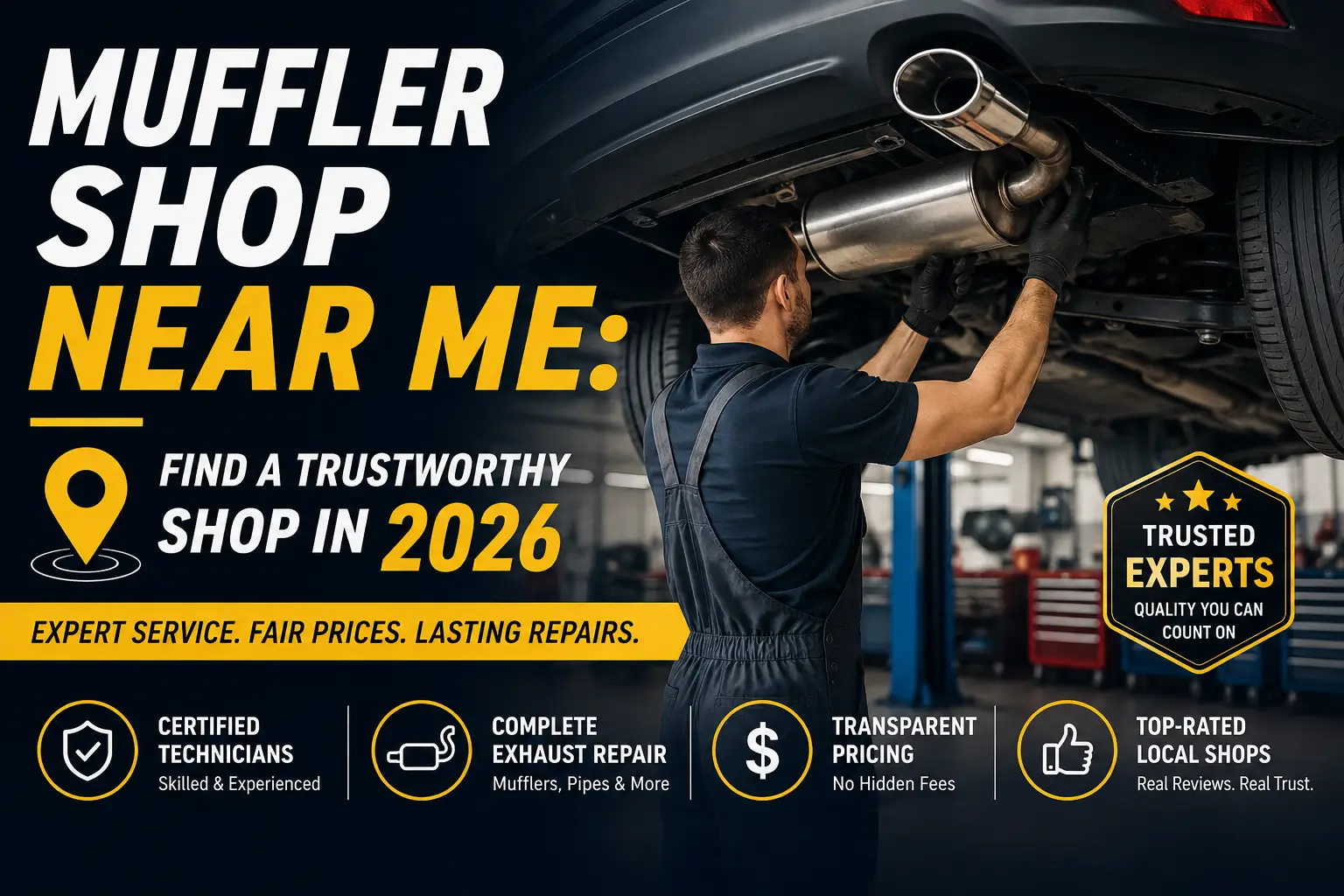
Quick Answer
Find a trustworthy muffler shop by comparing 2–3 certified shops, checking recent repair reviews, and getting a written quote. Expect muffler repairs around $80–$200 and replacements around $150–$600.
Who this guide is for:
U.S. vehicle owners searching “muffler shop near me” because their car is louder than normal, has failed (or is about to fail) an inspection, or shows warning signs of exhaust damage. If you own or manage a local muffler, exhaust, or auto repair shop and want to understand how customers actually evaluate a shop before they call, the vetting criteria below double as a checklist for what your own listing, reviews, and site need to demonstrate.
What “Muffler Shop Near Me” Actually Means
A muffler shop is a repair business that specializes in a vehicle’s exhaust system — the muffler (the noise-dampening chamber), the exhaust pipes, the resonator, hangers, gaskets, and often the catalytic converter, which controls emissions. This is different from three other places people sometimes mean when they search “muffler shop near me”:
- Full-service auto repair shop — handles exhaust work alongside brakes, engines, and general maintenance, rather than specializing in it.
- Dealership service center — services your specific vehicle brand and uses OEM (original equipment manufacturer) parts, usually at a higher labor rate.
- National franchise chains (e.g., Meineke, Midas) — exhaust-focused chains with standardized pricing and multiple locations, distinct from independently owned muffler shops.
Knowing which category a shop falls into before you call sets the right expectation for price, wait time, and part quality — a category-2 franchise and a category-4 independent specialist are not interchangeable, even though both can legitimately fix the same problem.
Why Choosing the Right Shop Matters?
A damaged exhaust system isn’t just a noise problem. Two real risks are at stake:
- Health and safety. A cracked exhaust pipe or leaking manifold can push carbon monoxide — an odorless, colorless gas — into the cabin, according to LegalClarity’s overview of U.S. muffler and exhaust equipment law. This is one of the reasons every state requires a working muffler on any vehicle driven on public roads.
- Legal compliance. States enforce exhaust noise limits, and several — including California, Maine, and Montana — use a decibel-based standard, generally capping street-legal exhaust noise around 95 dBA, according to a 2026 SlashGear review of state exhaust laws. New York’s SLEEP Act goes further: repair shops that install illegal noise-increasing equipment can face fines and risk losing their vehicle inspection certification after repeated violations, according to the New York Governor’s office. A shop that doesn’t understand these rules can leave you with a car that fails inspection or draws a ticket.
Signs You Actually Need Exhaust or Muffler Repair
Before you search for a shop, confirm the symptom actually points to the exhaust system:
- A loud rumbling or roaring noise that gets louder under acceleration
- A rattling sound from underneath the car, especially over bumps (often a loose hanger or heat shield)
- A rotten-egg or sulfur smell, which usually points to the catalytic converter, not the muffler
- Reduced fuel economy or a noticeable drop in power
- A check-engine light paired with an emissions-related code (commonly P0420)
- Visible rust, holes, or a hanging pipe section underneath the vehicle
If the symptom is a smell rather than noise, tell the shop that specifically — a general “my muffler is loud” description can send an inexperienced shop straight to a muffler swap when the real issue is the catalytic converter or a manifold leak, according to Ecostify’s 2026 exhaust system repair cost breakdown.
Muffler Shop vs. Dealership vs. Full-Service Repair Shop
| Factor | Independent Muffler Shop | Dealership Service Center | Full-Service Auto Repair Shop |
|---|---|---|---|
| Specialization | Exhaust systems only | All vehicle systems, brand-specific | All vehicle systems, general |
| Typical labor rate | $80–$150/hour | Usually highest, brand-set rates | Mid-range, varies by shop |
| Parts used | Aftermarket or OEM-equivalent, often more options | OEM (manufacturer) parts only | Mix of OEM and aftermarket |
| Best for | Standard muffler/exhaust repairs, faster turnaround | Vehicles under warranty, complex integrated exhaust systems | Bundling exhaust work with other repairs |
| Typical wait time | Often same-day for common repairs | Longer, appointment-based | Varies, appointment-based |
Independent muffler shops that specialize in exhaust work tend to offer the most price flexibility, according to PartCatalog’s 2026 muffler replacement cost guide, because their labor and inventory are built around exhaust jobs specifically rather than general repair.
What a Trustworthy Muffler Shop Should Do
Use this as a checklist when you call or visit:
- Inspects before quoting. A shop that gives you a firm price over the phone, before looking at the vehicle, is guessing — or padding the estimate.
- Itemizes the quote. The written estimate should separate parts, labor, and any additional exhaust components (hangers, gaskets, pipe sections) instead of one lump number.
- Explains repair vs. replacement. A small rust hole in an otherwise sound section can often be welded for $80–$200, according to EGR Performance’s 2026 exhaust repair cost guide — a shop that jumps straight to full replacement on every job is worth questioning.
- States the warranty in writing. Reputable shops back parts and labor with a written warranty period, not a verbal promise.
- Shows or explains the failed part. Ask to see the old muffler or corroded section. A shop confident in its diagnosis will show you.
- Is transparent about certification. ASE (National Institute for Automotive Service Excellence) certification signals technicians have passed standardized competency testing — ask if the shop’s exhaust technicians hold it.
Typical Muffler and Exhaust Repair Costs in 2026
Costs vary by vehicle, region, and how much of the exhaust system needs work, but recent 2026 data converges on a consistent range for standard passenger vehicles:
| Repair Type | Typical 2026 Cost Range | Source |
|---|---|---|
| Weld repair (small hole/leak) | $80–$200 | EGR Performance, 2026 |
| Muffler-only replacement, standard sedan | $150–$600 | Empire Auto Protect, 2026 |
| National average, muffler replacement | $200–$500 | Ecostify, 2026 |
| Muffler part only (before labor) | $50–$400 | A-Premium, 2026 |
| Catalytic converter replacement | $800–$2,500+ | Ecostify, 2026 |
| Independent shop labor rate | $80–$150/hour | PartCatalog, 2026 |
Regional labor rates swing the total meaningfully:
Labor costs vary by roughly 20–40% depending on geography, according to Suncent Auto’s 2026 exhaust leak repair cost guide, with urban coastal markets and states with stricter emissions rules (like California and New York) running toward the higher end due to required certified parts.
If you’re near a state line and the repair isn’t urgent, comparing quotes across the border can be worth the drive for a non-emergency fix.
Is an Aftermarket Exhaust or Muffler Delete Legal?
If your search for “muffler shop near me” is really about upgrading your exhaust note rather than fixing a failure, know the legal line first. Every state requires a working muffler on vehicles driven on public roads, and federal law separately prohibits tampering with emissions-control equipment like catalytic converters, according to LegalClarity.
A muffler delete (removing the muffler entirely) is legal for closed-course or off-road use in most states but is commonly cited, ticketed, or flagged at inspection when driven on public roads — enforcement and exact decibel thresholds vary by state, so a shop that offers a delete without asking where and how you drive the vehicle isn’t doing its job.
Street-legal alternatives — cat-back, axle-back, or performance mufflers that keep emissions components intact — can change the exhaust tone while staying within most states’ noise and inspection requirements.
How to Vet a Local Muffler Shop: A 7-Step Process
- Search and shortlist 3 shops within a reasonable driving distance, mixing at least one independent specialist and one franchise or dealership for price comparison.
- Read the most recent reviews, not just the overall star rating — look for mentions of a specific repair (e.g., “fixed a resonator leak in under an hour”) rather than vague praise.
- Call and describe the exact symptom (noise, smell, dashboard light) and ask whether they’ll inspect before quoting.
- Ask about certification and warranty directly: “Are your techs ASE-certified, and what’s your warranty on parts and labor?”
- Get a written estimate after inspection, itemized by part and labor.
- Compare the second quote before authorizing work — a second opinion on anything over roughly $300 is standard practice, not an insult to the first shop.
- Confirm the fix in writing covers the actual root cause (e.g., a hanger and a weld, not just a muffler swap) before you approve the final invoice.
A Real-World Example!
A driver with a 2016 mid-size sedan brings the car in after noticing a rattling noise over bumps and a slightly louder idle. A shop that skips inspection might quote a full muffler replacement at $400–$500 over the phone. A shop that follows the process above finds the actual cause is a broken rubber hanger letting the muffler swing and hit the underbody .
A repair that, per Axle Advisor’s 2026 cost data, typically runs closer to $30–$100 for the hanger and labor, with no muffler replacement needed at all. The lesson: the same symptom can point to a $50 fix or a $500 one, and only an in-person inspection tells you which.
Red Flags to Avoid!
- Quoting a price over the phone with no inspection
- Pushing a full exhaust system replacement when the symptom description points to one small component
- No written estimate or warranty offered
- Reviews that are overwhelmingly generic, very recent, and unusually uniform in wording (a sign of incentivized or fake reviews)
- Refusing to show you the failed part
- Offering to bypass emissions equipment without asking about your state’s inspection rules
From the Shop’s Side: Why This Vetting Process Matters for Local Visibility
Everything above is what a driver does before ever walking through your door — and it starts online, long before the phone call. If you run a muffler, exhaust, or general auto repair shop, the reviews, business listing details, and website content a customer checks during Steps 2–4 above are exactly what local SEO work is built to strengthen.
Accurate service listings, consistent business information across directories, and content that answers the exact questions (“do you inspect before quoting,” “are your techs certified”) customers are already searching for. The review pattern in Step 2 — recent, specific, and detailed — doesn’t happen by accident either.
It’s the direct result of an active reputation management process that requests and responds to reviews consistently rather than leaving them to chance. A shop that does excellent work but is invisible in local search, or has thin and outdated reviews, loses the comparison in Step 6 before the customer ever calls.
Key Takeaways
- “Muffler shop near me” can mean an independent specialist, a franchise, a dealership, or a full-service garage — know which one you’re calling.
- A trustworthy shop inspects before quoting, itemizes the estimate, and puts the warranty in writing.
- Expect $150–$600 for a standard muffler replacement and $80–$200 for a weld repair, per 2026 industry cost data; catalytic converter work runs significantly higher.
- Every state requires a working, unmodified muffler on public roads — check local noise and inspection rules before any aftermarket exhaust work.
- Comparing two to three quotes and reading recent, specific reviews is the single most reliable way to avoid overpaying or getting the wrong repair.
FAQs
Is it worth going to a specialized muffler shop instead of my dealership in 2026?
For a standard muffler or exhaust repair on a non-warranty vehicle, yes — independent muffler shops typically offer more price flexibility and comparable or faster turnaround, according to PartCatalog’s 2026 cost data, since their labor and inventory are built specifically around exhaust work.
Dealerships make more sense if your vehicle is still under warranty or has an integrated, brand-specific exhaust system.
How much should a muffler repair near me actually cost?
For most passenger vehicles in 2026, a full muffler replacement runs $150–$600, and a smaller weld repair on a rust hole or leak runs $80–$200, according to Empire Auto Protect and EGR Performance’s 2026 cost guides.
Get a written, itemized quote after an in-person inspection rather than relying on a phone estimate, since the final cost depends heavily on your specific vehicle and region.
What’s the difference between a muffler repair and a muffler delete?
A muffler repair fixes or replaces the existing sound-dampening component to restore normal function. A muffler delete removes it entirely, which changes the exhaust note but is generally not street-legal in most states when driven on public roads, according to Legal Clarity’s overview of state exhaust laws — it’s intended for closed-course or off-road vehicles.
Can a bad muffler or exhaust leak actually be dangerous, not just loud?
Yes. A cracked or leaking exhaust component can allow carbon monoxide — an odorless, colorless gas — to enter the cabin, which is one reason every state legally requires a functioning muffler on vehicles driven on public roads.
A rattling or hissing noise from underneath the car should be inspected promptly rather than treated as only a noise issue.
Why do quotes for “muffler shop near me” vary so much between shops?
Pricing differs based on vehicle type, whether OEM or aftermarket parts are used, local labor rates (which can vary 20–40% by region, according to Suncent Auto’s 2026 data), and how much of the exhaust system needs work beyond the muffler itself.
A quote that’s dramatically lower than others is worth double-checking for what it excludes — hangers, gaskets, or a catalytic converter that may need to be addressed separately.
Will an aftermarket performance muffler make my car fail an inspection?
It can, particularly in states with decibel-based noise limits like California, Maine, and Montana, where exhaust noise above roughly 95 dBA is illegal regardless of the part’s brand, according to a 2026 SlashGear review of state exhaust laws.
Ask the shop specifically whether the part they’re installing is certified as street-legal and inspection-compliant in your state before agreeing to the upgrade.