Quick Answer:
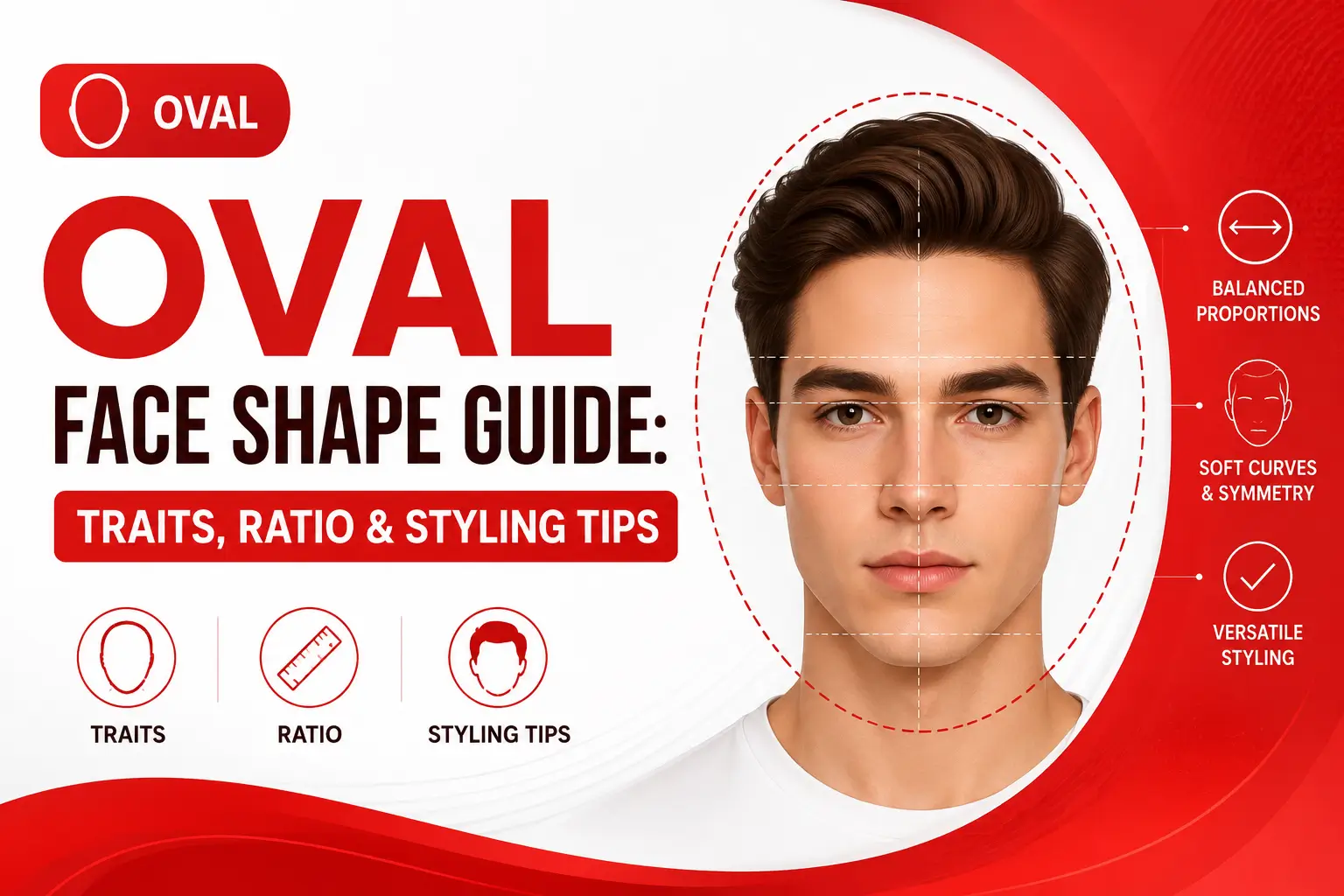
An oval face is longer than it is wide — commonly a 1.3–1.5:1 ratio — with cheekbones as the widest point, a forehead slightly wider than the jaw, and a softly rounded jawline. It’s the most versatile face shape for styling.
If you’re trying to confirm your face shape before choosing a haircut, glasses, or beard style, this guide at OvalFaceShape.com is for you. It’s also useful if you’re a stylist or optician cross-checking a client’s shape, or if you’re comparing oval against a neighboring shape like round or oblong and aren’t sure which one fits.
An oval face is defined by a length-to-width ratio commonly cited between 1.3 and 1.5, cheekbones as the widest point, and a gently rounded jaw with no sharp angles.
What Is an Oval Face Shape?
An oval face shape has four consistent traits:
The face is visibly longer than it is wide, the cheekbones form the widest point, the forehead is slightly wider than the jaw, and the jawline curves softly rather than angling sharply. No single feature dominates — that balance is what makes oval the reference point stylists use when designing cuts for other shapes.
This differs from a medical diagnosis. Face shape here describes external proportion for styling purposes, not a clinical classification — useful context if you’ve seen “oval” used loosely in cosmetic-procedure marketing.
The Anthropometric Basis: Why the Ratio Range Matters
Published sources disagree on the exact oval ratio — some say 1.3, others 1.5, others a 1.25–1.45 range. That spread exists because measurement points vary slightly by source (forehead vs. temple width, hairline vs. brow start), not because the underlying shape is inconsistent.
The measurement points behind these ratios trace back to modern craniofacial anthropometry, most comprehensively catalogued in Farkas’s Anthropometry of the Head and Face — still the standard reference for facial landmark measurement in both clinical and cosmetic contexts.
A related body of research has also tested how facial ratios compare to the classical golden ratio (phi, 1.618), finding meaningful variation by population and measurement method rather than a single universal “ideal” number.
For styling purposes, the practical takeaway is simpler than the research: if your measured ratio falls in the 1.3–1.5 range with cheekbones as your widest point, you’re oval.
Oval vs. Round, Oblong, and Heart Face Shapes
| Face Shape | Length : Width | Widest Point | Jawline |
|---|---|---|---|
| Oval | ~1.3–1.5 : 1 | Cheekbones (slightly) | Soft, rounded |
| Round | ~1 : 1 | Cheeks | Soft, no angles |
| Oblong | 1.5 : 1 or higher | Even forehead/cheek/jaw | Straight, less tapered |
| Heart | ~1.3–1.5 : 1 | Forehead | Narrow, pointed chin |
The most common mix-up is oval vs. round:
Round faces have length and width that are nearly equal, while oval is measurably longer than wide. The second most common is oval vs. oblong: both are longer than wide, but oblong keeps forehead, cheek, and jaw widths nearly identical, while oval’s cheekbones noticeably lead.
How to Confirm You Have an Oval Face Shape?
- Is your face visibly longer than wide? No → likely round or square. Yes → continue.
- Are your cheekbones the widest point? No, forehead is widest → likely heart. Yes → continue.
- Is your jaw soft and rounded, not straight-sided? No, sides run parallel → likely oblong. Yes → you’re oval.
For a precise result rather than visual guesswork, the Face Shape Detector on this site maps your facial landmarks from a photo and calculates your exact ratio in seconds — useful once you’ve narrowed things down with the steps above but want a confirmed number.
Real Examples:
Oval Face Shapes in Public Life
Style publications and beauty guides commonly point to Jennifer Lopez, Bella Hadid, and Beyoncé as examples of an oval face shape in women, and George Clooney and Jake Gyllenhaal in men — in each case, the defining tell is the balanced cheekbone-to-jaw taper rather than any single dramatic feature.
Styling an Oval Face Shape: The High-Level Approach
Because oval is already balanced, the styling goal isn’t correction — it’s enhancement. Most hairstyles work, from pixie cuts to long layers; the main things to manage are avoiding excess length (which can stretch the face further) and adding width at the cheek line if you want more definition.
The same logic applies to glasses:
Most frame shapes suit oval faces, though frames roughly as wide as your face’s widest point tend to look most proportional. For the full breakdown by hair type, frame shape, and beard style, see the dedicated Hairstyle by Face Shape, Glasses by Face Shape, and Beard Styles by Face Shape guides.
Common Misconceptions
A common misconception is that “oval” is a fixed, narrow category — in practice, many real faces sit near the oval/round or oval/oblong boundary, and that’s normal rather than a measurement failure.
Another is that face shape is permanent regardless of context.
Hairstyles, camera angle, and even smiling can shift how a face reads, though the underlying bone-based ratio doesn’t change.
Key Takeaways
- Oval is defined by a 1.3–1.5:1 length-to-width ratio, cheekbones as the widest point, and a soft jawline.
- Ratio disagreement across sources comes from measurement-point differences, not shape inconsistency.
- Oval sits closest to round on one side and oblong on the other — check the jaw taper and side-line straightness to tell them apart.
- Use the Face Shape Detector for a precise, photo-based confirmation rather than relying on visual guesswork alone.
- Styling an oval face is about enhancement, not correction.
FAQs
Is oval the most attractive face shape?
Oval is frequently described as the most versatile for styling because of its balanced proportions, but “most attractive” is subjective and not something research settles definitively — versatility and attractiveness aren’t the same claim.
Is an oval face shape still relevant to know in 2026?
Yes — even with AI detectors doing the measuring now, the underlying proportions still determine which hairstyles, glasses, and beard shapes are genuinely flattering, so knowing your shape remains useful regardless of how you measure it.
What’s the difference between oval and oblong face shapes?
Both are longer than wide, but oval has cheekbones as a clear widest point with soft tapering, while oblong keeps forehead, cheek, and jaw widths nearly equal with straighter sides.
How do I measure my face shape at home?
Use a soft tape measure for face length (hairline to chin), forehead width, cheekbone width, and jaw width, then compare the ratios — or use the Face Shape Detector for an instant photo-based result.
Can your face shape change over time?
The underlying bone proportions are largely stable in adulthood, though visible changes in weight, muscle tone, or aging can shift how rounded or defined a face appears without changing the bone ratio itself.
Do oval faces suit all hairstyles?
Most hairstyles work well on an oval face because no single feature needs correcting, though very long styles can add unwanted length and very heavy fringes can visually shorten the face toward round.
Why do AI face shape tools sometimes disagree with each other?
Different tools use different landmark points and threshold values, so a face near a boundary (like oval/round or oval/oblong) can be classified differently depending on which tool and which exact measurements are used.